The AI Visibility Audit: A 25-Point Checklist Across Search, Listings, Social, and Reviews

Search behavior has quietly split in two. People still type queries into Google, but a growing share of them now ask ChatGPT, Perplexity, Gemini, or Google's AI Overviews instead, and get a synthesized answer with zero or few clicks involved. If your brand isn't part of the data these tools pull from, you don't just rank lower — you disappear from the conversation entirely.
That's what an AI Visibility Audit is for: a systematic check of whether AI systems can find you, understand you, trust you, and recommend you. It borrows from traditional SEO and local SEO audits, but adds a new layer, because large language models don't crawl and rank the way search engines do. They synthesize answers from whatever structured, consistent, and corroborated information they can find about you across the web.
Below is a 25-point checklist organized into four pillars: Search & Content, Listings & Structured Data, Social Presence, and Reviews & Trust Signals. Run through it quarterly, and you'll have a clear, prioritized map of where your AI visibility is strong and where it's leaking.
Pillar 1: Search & Content
AI answer engines still lean heavily on indexed, crawlable content. If your content isn't structured for extraction, it won't be cited — no matter how good it is.
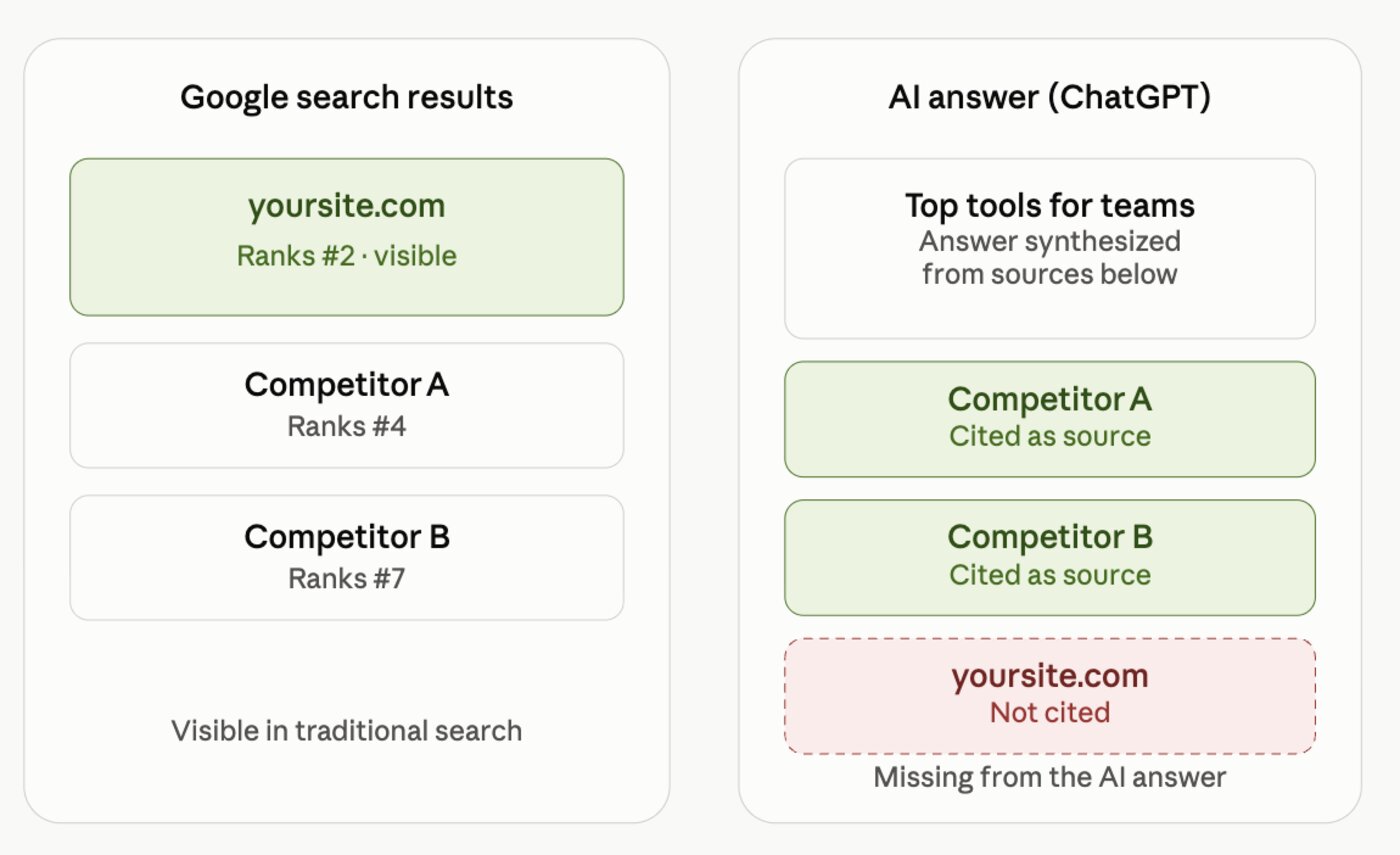
- 1. Crawlability for AI bots. Check whether your robots.txt blocks GPTBot, ClaudeBot, PerplexityBot, Google-Extended, and CCBot. If you want AI visibility, you generally need to allow these crawlers — blocking them keeps you out of the training and retrieval data these tools draw from.
- 2. Presence in AI Overviews / SGE. Search your core commercial and informational keywords in Google and note whether an AI Overview appears, and whether your domain is cited within it. Track this over time — Overviews rotate sources frequently.
- 3. Citation frequency in ChatGPT, Perplexity, and Gemini. Manually query these tools with the questions your customers actually ask ("best project management tool for small teams," "top dermatologist in Austin"). Note whether your brand is mentioned, and whether it's cited as a source.
- 4. Answer-first content structure. Do your key pages open with a direct, extractable answer (definition, summary, direct response) before going into detail? AI systems favor content that answers a question in the first 1–2 sentences.
- 5. FAQ and Q&A formatting. Pages with clearly formatted question-and-answer sections (using actual <h2>/<h3> questions) get pulled into AI answers far more often than prose-only pages. Audit your top 10 pages for this.
- 6. Topical depth and entity coverage. Does your content cover a topic comprehensively enough that an LLM could treat your site as a primary source, rather than one input among many? Thin, single-angle content rarely gets cited.
- 7. Freshness and update cadence. Check publish/update dates on cornerstone content. AI systems weight recency, especially for anything price-, product-, or fact-sensitive. Stale pages get quietly dropped from citation pools.
- 8. Schema markup coverage. Audit for Organization, Product, FAQPage, Article, and Review schema across key pages. Structured data is one of the clearest signals LLMs and AI Overviews use to extract facts accurately — missing or broken schema is one of the highest-leverage fixes on this list.
Pillar 2: Listings & Structured Data
We analyzed more than 350,000 business profiles and found that only a small fraction were ever surfaced by AI assistants when users asked for recommendations. AI systems, it turned out, were evaluating confidence — not just relevance — and excluding anything they couldn't verify. AI tools cross-reference business directories to verify facts about you. Inconsistency here doesn't just hurt local SEO; it actively confuses AI models about who you are.
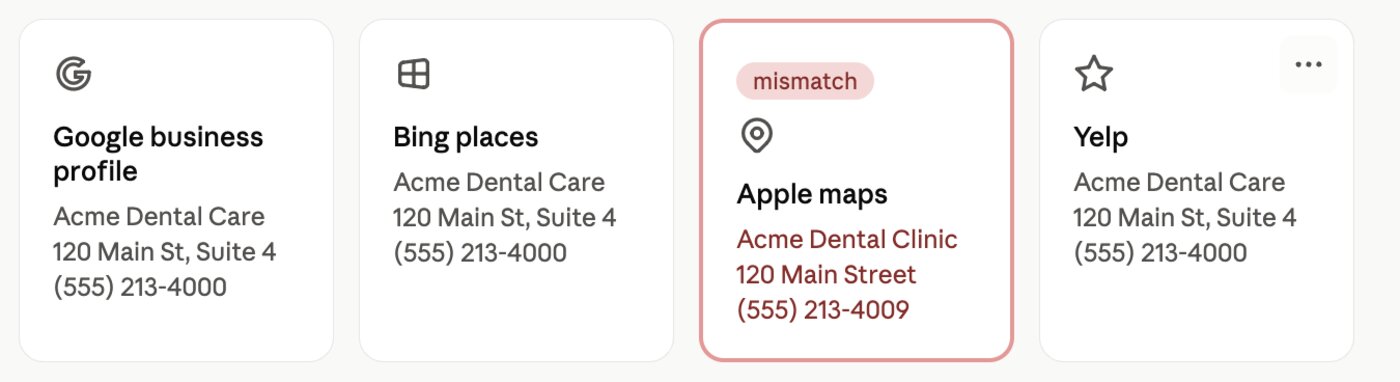
- 9. NAP consistency (Name, Address, Phone). Check Google Business Profile, Bing Places, Apple Maps, Yelp, and industry-specific directories. Any mismatch in name formatting, address, or phone number creates ambiguity that AI systems either flag or silently discard.
- 10. Google Business Profile completeness. Category selection, hours, attributes, services, products, and Q&A section should all be fully filled out. GBP data feeds directly into Google's AI Overviews and local AI answers.
- 11. Bing Places / Microsoft presence. Often ignored, but Bing data feeds Copilot and ChatGPT's Bing-powered search plugin. An incomplete or missing Bing listing is a common, easy-to-fix gap.
- 12. Apple Business Connect listing. Increasingly relevant as Apple Intelligence and Siri lean on Apple Maps data. Confirm your listing exists and is claimed.
- 13. Industry and niche directories. Depending on your sector (legal, medical, real estate, home services), check presence on the 3–5 directories AI models most commonly cite for that vertical (e.g., Avvo for law, Healthgrades for medical).
- 14. Wikipedia / Wikidata presence. If eligible, a well-maintained Wikipedia page and linked Wikidata entry is one of the strongest entity-verification signals for LLMs. Audit for accuracy if one already exists — outdated Wikipedia info gets propagated into AI answers for years.
- 15. Knowledge Panel accuracy. Search your brand name and check Google's Knowledge Panel (if you have one) for accuracy, logo, description, links, and social profiles. Claim and correct it if you haven't already.
Pillar 3: Social Presence
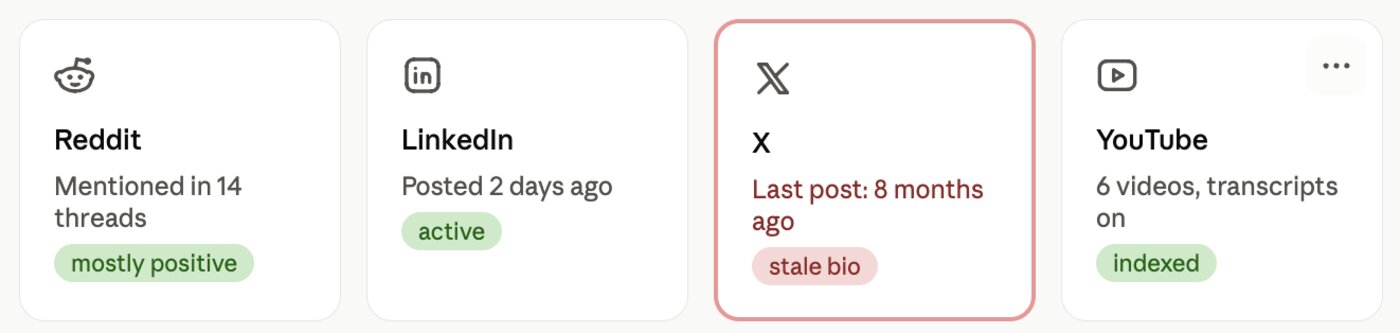
AI models increasingly pull from social platforms for sentiment, recency, and "what people are saying" context — especially Reddit, LinkedIn, and X.
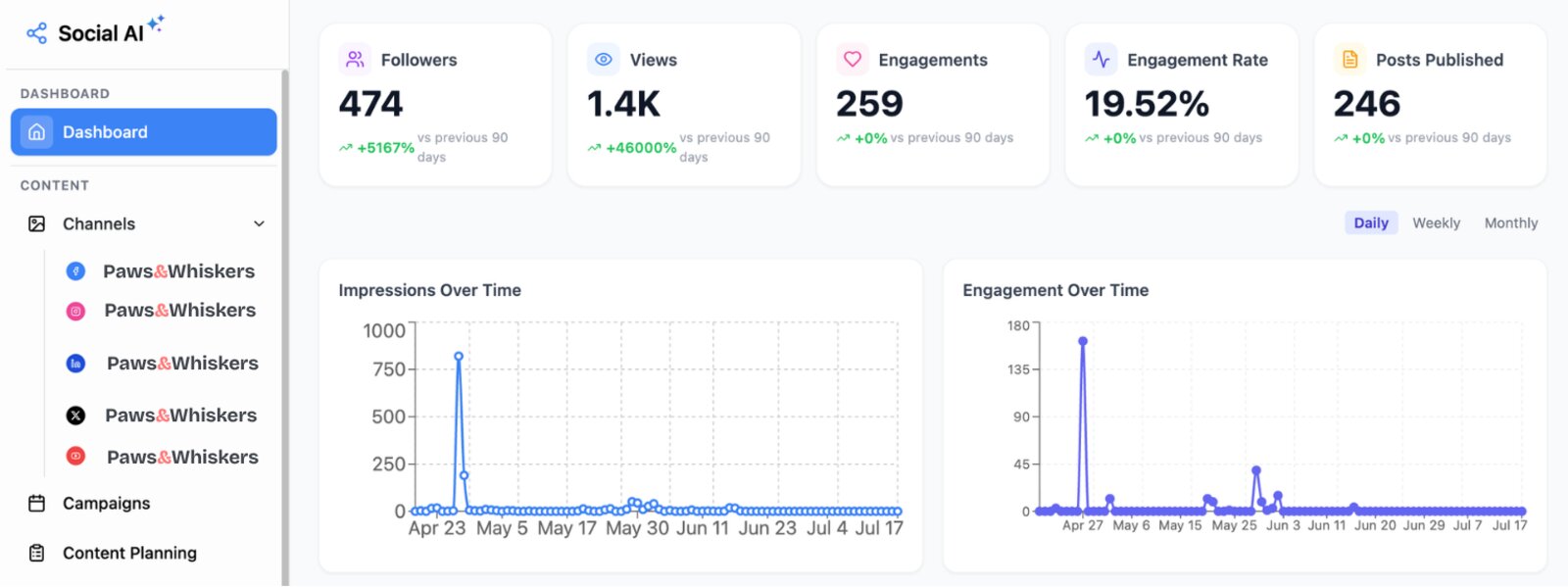
- 16. Reddit presence and sentiment. Search your brand and product names on Reddit directly. LLMs (particularly ChatGPT and Perplexity) heavily weight Reddit threads as a trust signal. Note whether the sentiment is positive, mixed, or nonexistent.
- 17. LinkedIn company page activity. Check for regular posting, complete company details, and employee association. B2B AI queries draw disproportionately on LinkedIn data.
- 18. YouTube presence and transcripts. Video with accurate, keyword-rich titles and transcripts gets indexed and cited by AI systems as a distinct source type. Audit whether you have any video content answering your core customer questions.
- 19. Cross-platform bio and description consistency. Compare your "About" text across Instagram, X, LinkedIn, Facebook, and YouTube. Inconsistent positioning or outdated descriptions create the same ambiguity problem as inconsistent NAP data.
- 20. Third-party mentions and unlinked citations. Search your brand name (without site: operators) to find blog mentions, forum discussions, and press coverage that don't link back to you. These unlinked mentions still function as corroborating signals for AI entity recognition.
Pillar 4: Reviews & Trust Signals
Reviews are one of the strongest trust signals AI systems use when deciding whether to recommend a business — and one of the easiest to audit systematically.
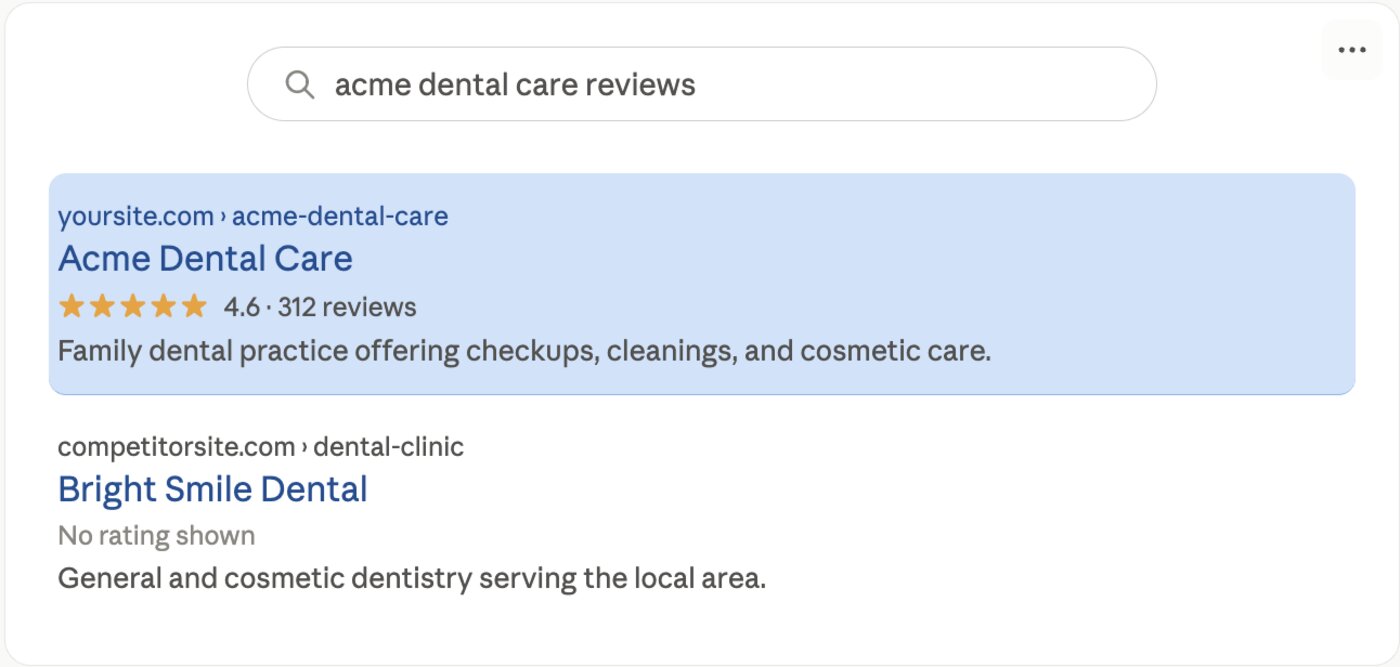
- 21. Review volume and velocity. Compare your review count and recent review pace (last 90 days) against your top 3 competitors on Google and your primary industry platform. AI recommendation engines favor businesses with consistent, recent review activity over those with a large but stagnant historical count.
- 22. Average rating threshold. Most AI systems appear to favor businesses at or above a 4.2–4.5 rating when generating recommendations. If you're below that band, this becomes a priority fix.
- 23. Review response rate. Check what percentage of your reviews — especially negative ones — have an owner response. Response rate and tone are both increasingly used as trust and service-quality signals.
- 24. Review content depth. Short, generic reviews ("Great service!") carry less extraction value than detailed reviews that mention specific products, staff, or outcomes. Detailed reviews give AI models more concrete facts to cite.
- 25. Multi-platform review distribution. Audit whether your reviews are concentrated on a single platform or spread across Google, Yelp, Facebook, Trustpilot, and industry-specific sites. A single-platform concentration is a fragility risk, and AI tools cross-reference multiple platforms to validate sentiment before citing it.
How to Run This Audit
You don't need special tooling to get started — a spreadsheet with 25 rows, a "pass/fail/partial" column, and a priority column will do. A practical approach:
- Score each point as Strong / Needs Work / Missing.
- Weight by effort vs. impact — schema markup and GBP completeness are usually high-impact, low-effort fixes; Wikipedia notability is high-impact but high-effort.
- Re-run the manual AI queries (points 2 and 3) monthly, since AI Overviews and LLM citation patterns shift faster than traditional search rankings.
- Fix in this order: structured data and crawlability first (foundation), listings second (consistency), reviews third (trust), social last (amplification) — though sequencing can flex based on your audit results.
Final Thoughts
Traditional SEO optimizes for ranking. AI visibility optimizes for being the answer — the source an AI model trusts enough to cite or recommend without the user ever clicking through. That shift rewards consistency, structured data, and verifiable trust signals over keyword density and backlink volume alone.
None of these 25 points require a massive budget. Most are fixes you can start today: cleaning up NAP inconsistencies, filling out a Google Business Profile, adding schema markup, or simply asking ChatGPT and Perplexity what they currently know about your brand. The businesses that treat AI visibility as a real, ongoing discipline — not a one-time project — are the ones that will keep showing up as AI-driven search takes a larger share of how people find and choose brands.
Run this checklist today, and you'll know exactly where your brand stands — and where the highest-leverage fixes are — before your competitors even realize the game has changed.
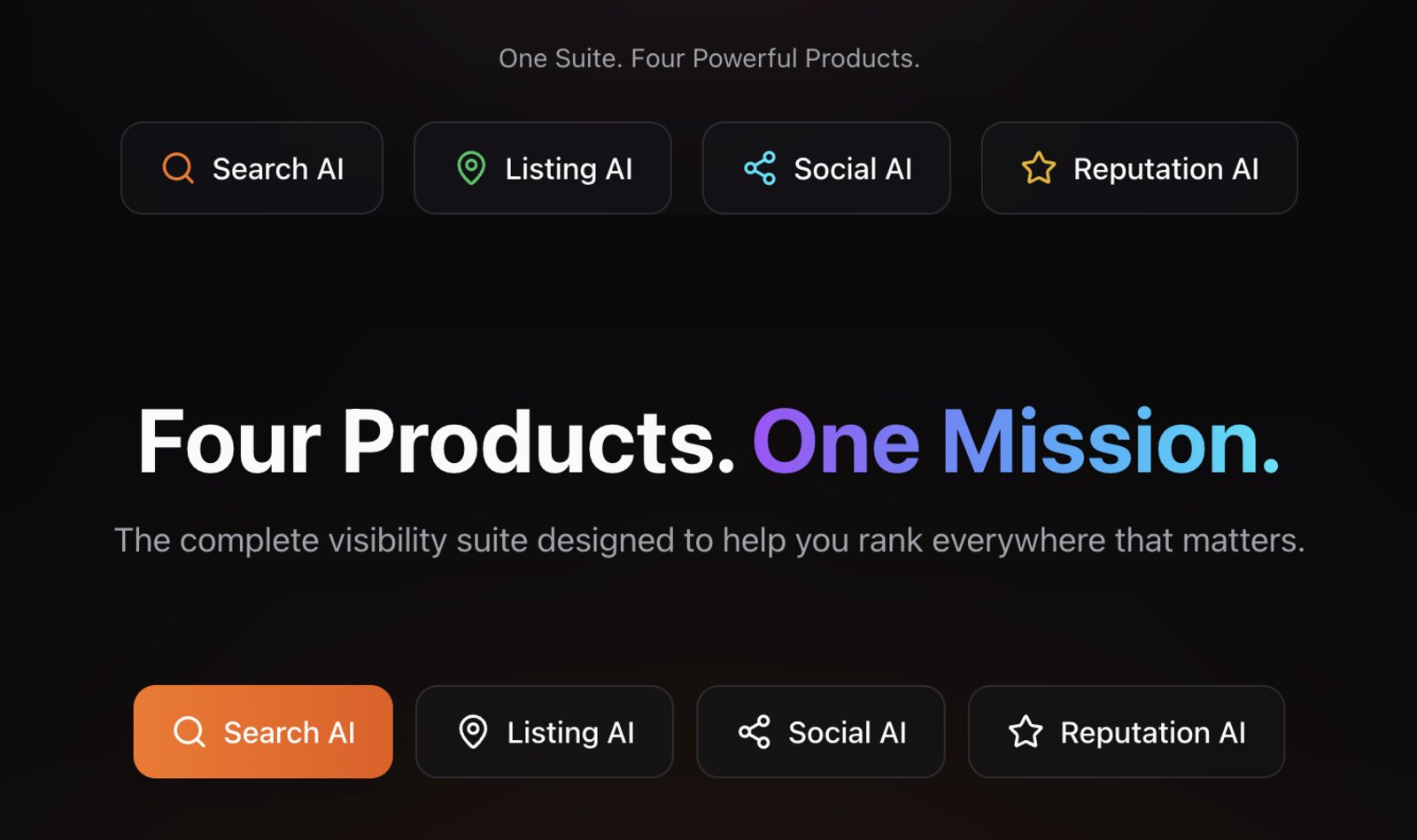
Want this handled for you instead of manually? RankRabbit AI covers all four pillars in this audit under one platform — Search AI, Listing AI, Reputation AI, and Social AI — so you can track, fix, and monitor your AI visibility continuously instead of running this checklist by hand every quarter.
Frequently Asked Questions
What is AI visibility?
AI visibility is how easily and accurately AI systems — like ChatGPT, Google AI Overviews, Perplexity, and Gemini — can find, understand, and recommend your brand when someone asks a relevant question. It depends on structured data, content clarity, listing consistency, and third-party trust signals like reviews, rather than traditional keyword rankings alone.
How is AI visibility different from traditional SEO?
Traditional SEO focuses on ranking a page in search results so users click through. AI visibility focuses on becoming a trusted, citable source that an AI model references directly in its answer, often without the user visiting your site at all. It relies more heavily on structured data, consistency across the web, and third-party corroboration (reviews, directories, Reddit, Wikipedia) than on backlinks or keyword density alone.
Which AI tools should I check my brand visibility on?
The easiest way is to use RankRabbit AI, which tracks your brand visibility across all the major AI answer engines — ChatGPT, Google AI Overviews, Perplexity, and Gemini — in one place, instead of manually checking each tool one by one. If you're doing it manually, run your core customer questions through each of these four platforms individually, since each pulls from a different mix of sources and visibility on one doesn't guarantee visibility on another.
How often should I run this audit?
Do a full 25-point pass quarterly. Re-check points 2 and 3 (AI Overview and chatbot citation checks) monthly, since AI answer engines update their source selection far more frequently than Google updates traditional rankings.
What's the single highest-impact fix on this list?
For most businesses, it's schema markup combined with Google Business Profile completeness (points 8 and 10). Both are relatively fast to fix and feed directly into the structured data that AI systems rely on most heavily for factual accuracy.
Does blocking AI crawlers protect my content?
It can protect against your content being used in AI training, but it also removes you from the data pool these tools draw on when generating answers — meaning you likely won't be cited or recommended. Weigh this trade-off deliberately rather than leaving robots.txt on default settings.
Do reviews really affect AI recommendations?
Yes. AI systems appear to treat review volume, recency, average rating, and response rate as trust signals when deciding whether to recommend a business in an answer. A business with sparse, old, or low-rated reviews is less likely to be surfaced than a well-reviewed competitor, even if their website content is stronger.
Hastimal Jangid (HM) is a Co-founder at Coozmoo — the #1 rated AI-powered, data-driven digital marketing agency built to skyrocket revenue for small and medium-sized businesses — and the engineering mind behind RankRabbit.ai, Coozmoo's proprietary AI-powered growth platform that scaled to $2M ARR in its first year.
As Head of Cloud Engineering & Automation, he architects the technology backbone behind every service Coozmoo delivers — from AI-powered search visibility and paid media intelligence to e-commerce automation and conversion optimization. RankRabbit.ai sits at the center of this engine, combining agentic AI, intelligent automation, and real-time data intelligence to help SMBs dominate both traditional search engines and the next generation of AI-powered discovery platforms — ChatGPT, Perplexity, Gemini, and beyond.
A 4× AWS Certified Cloud Architect with 15+ years of experience, Hastimal brings a rare combination of deep technical engineering, fintech-grade discipline, and a founder's instinct for commercial impact. He doesn't just build systems — he builds systems that grow businesses. RankRabbit.ai is proof of that.
Ready to capture high-intent buyers?
See how RankRabbit helps your business rank everywhere — and win where it actually counts.