Why Business Listings Are the Backbone of AI Search: How ChatGPT, Gemini, and Maps Decide Which Businesses to Recommend

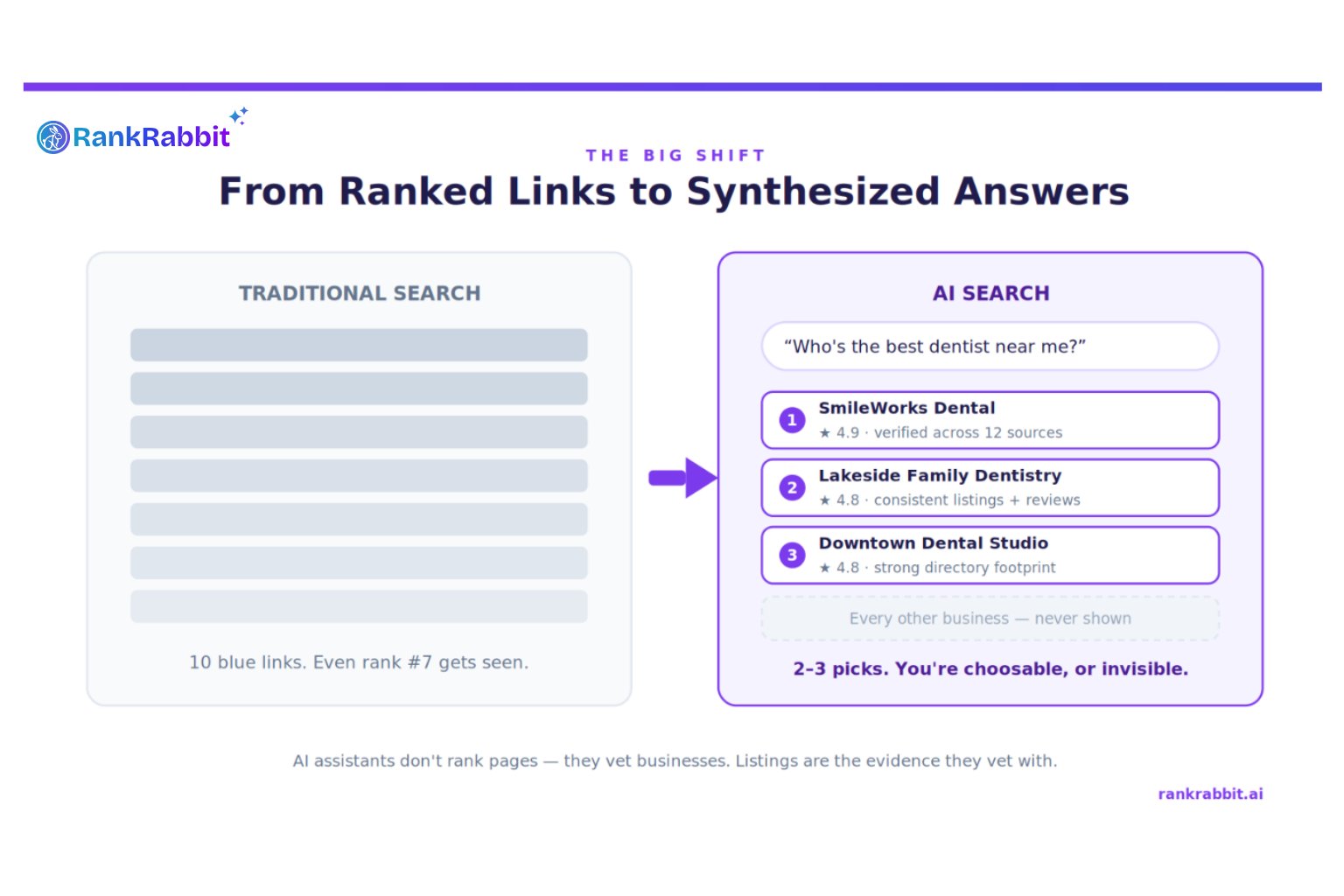
Ask ChatGPT for "the best dentist near me." Ask Gemini for "a reliable HVAC company in Austin." Ask your car's voice assistant to "find a coffee shop that's open right now."
In each case, you don't get ten blue links. You get an answer, two or three businesses, named with confidence, often with ratings, hours, and a map pin attached. One of those businesses gets the call. The rest were never even seen.
This is the single biggest shift in local discovery since Google Maps launched, and it raises the question every business owner should be asking: how did the AI pick those businesses?
The answer is less mysterious than most people assume. AI assistants don't "know" your business. They assemble a picture of it from the data that exists about you across the web and the richest, most machine-readable, most cross-verifiable form of that data is the humble business listing. Your Google Business Profile. Your Yelp page. Your Apple Maps and Bing Places entries. Your Foursquare record. Your industry directory profiles.
Listings were once treated as a "set it and forget it" checkbox in local SEO. In the AI era, they've become the backbone of whether you get recommended at all. Here's exactly how it works, platform by platform, and what to do about it.
The Big Shift: From Ranked Links to Synthesized Answers
Traditional search gave every business a fighting chance on the results page. Even ranking seventh meant visibility. AI search works differently: the model retrieves information from a set of sources, weighs and reconciles it, and then synthesizes a short answer that names only a handful of businesses.
That changes the math of visibility in three important ways:
- The answer set is tiny. An AI recommendation typically surfaces two to five businesses, not ten or twenty. Being "findable" is no longer enough — you have to be choosable by the model.
- You can't see when you lose. There's no ranking report for the recommendation you didn't get. A prospect asks an assistant for a plumber, receives three names, calls one — and you never knew you were in (or out of) consideration.
- The AI is doing the vetting. Instead of a human scanning results and judging credibility, the model does it by cross-referencing what it finds about you across multiple independent sources.
And this is no longer a fringe behavior. Industry tracking shows AI-assisted discovery has exploded: consumer AI usage for local search jumped from roughly 6% in 2025 to around 45% in 2026, while Google's AI Overviews now appear on approximately 40% of local-intent queries and reach over two billion users monthly. Meanwhile, AI-driven search features are estimated to influence well over half of all search queries.
The businesses winning in this environment aren't necessarily the ones with the biggest ad budgets. They're the ones whose data is the easiest for machines to find, trust, and verify.
How AI Systems Actually Decide: Retrieval, Corroboration, and Trust
Before looking at each platform, it helps to understand the general mechanics. When an AI assistant answers a local query, three things happen behind the scenes:
1. Entity resolution
The system has to figure out that "Joe's Plumbing," "Joes Plumbing LLC," and "Joe's Plumbing & Drain" scattered across the web are (or are not) the same business. Listings are the primary raw material for this. Consistent name, address, and phone number (NAP) data across platforms lets the model confidently merge records into a single, well-understood entity. Inconsistent data fragments your identity — and a fragmented entity is a weak candidate for recommendation.
2. Retrieval and grounding
Most AI answers about local businesses aren't produced from the model's memory alone. The system retrieves live or recently indexed data — from search indexes, licensed location databases, review platforms, and directories — and grounds its answer in what it finds. If your business is thin or absent in those sources, there's simply nothing to retrieve.
3. Corroboration
This is the part most businesses underestimate. AI systems don't rely on a single source, they cross-reference your business details across dozens of platforms simultaneously, and when the data conflicts, even a small mismatch like "St." versus "Street" can flag the business as unreliable. A business whose website, Google profile, Yelp page, Apple Maps entry, and industry directory listings all tell the same story gives the model strong, corroborated evidence. As one analysis of AI sourcing put it, the businesses dominating AI recommendations are the ones with strong signals across all sources — the AI isn't looking at any single platform, it's synthesizing everything.
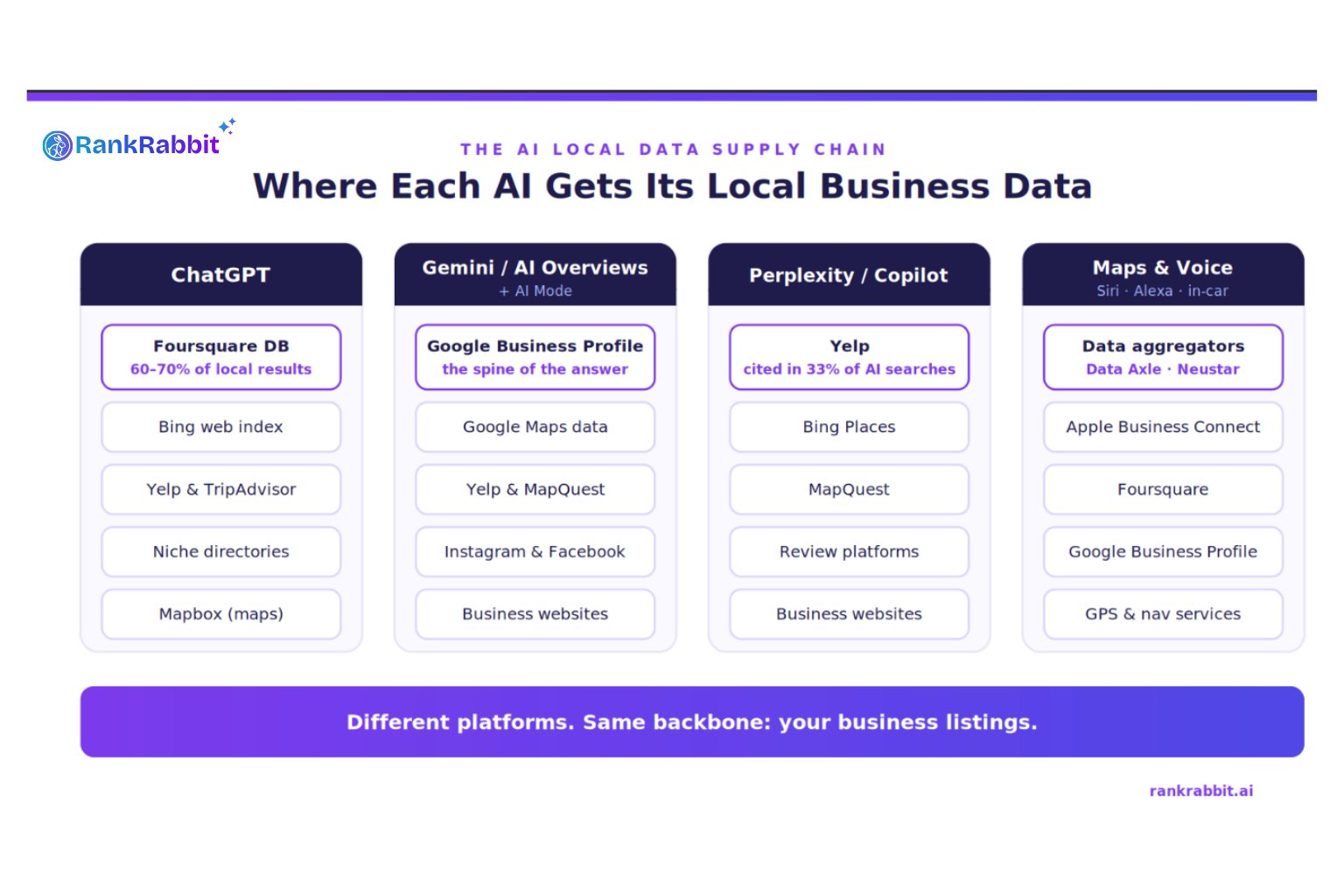
In short: listings aren't just where AI finds your business. They're how AI decides whether to trust your business.
Where Each AI Gets Its Local Data: Platform by Platform
ChatGPT: Bing's Index and Foursquare's Database
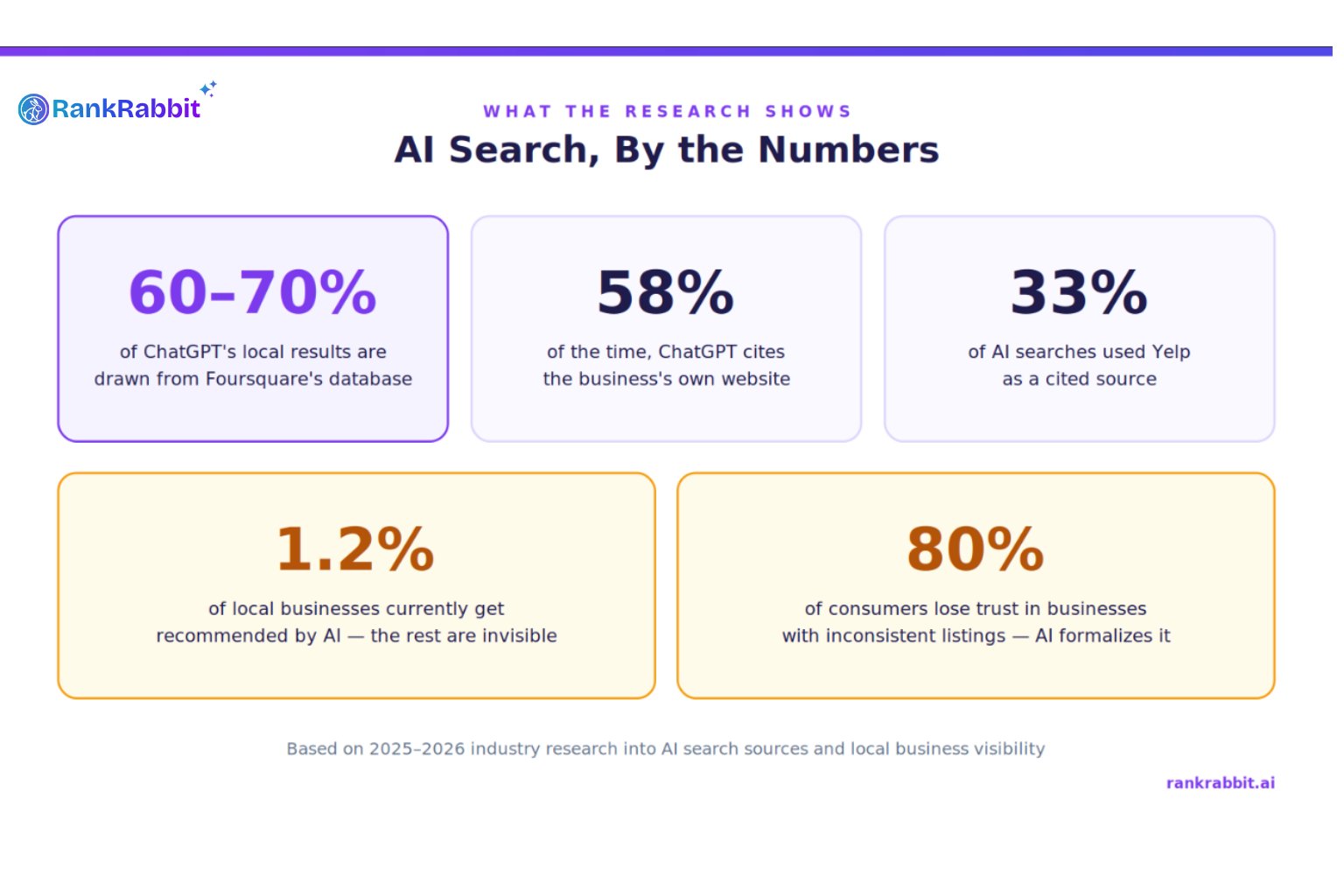
ChatGPT's local data supply chain is surprisingly different from Google's. Its live retrieval runs on Bing's web index, not Google's, so a meticulously maintained Google Business Profile does nothing for a business whose Bing Places listing sits unclaimed. For map-style results, reports suggest 60–70% (some say more) of ChatGPT's local answers are drawn from Foursquare's licensed database, with maps rendered by Mapbox. Beyond that, it leans on Yelp, TripAdvisor, and niche directories. If you're weak in these sources, you're invisible to ChatGPT, however strong you are on Google.
Gemini, AI Overviews, and AI Mode: Google's Data Moat
Google's AI surfaces treat Google Business Profile as the spine of the answer — even when GBP isn't the cited source, AI Mode still summarizes its details in results. But they don't stop there: AI Mode also pulls from Yelp, MapQuest, Instagram, and Facebook. Freshness matters too; stale profiles see impression drops, while complete, active ones remain the single biggest lever for Google AI visibility.
Perplexity and Copilot: The Directory Omnivores
Perplexity is the most transparently listings-dependent. Yelp appeared in 33% of all searches, and Perplexity used it in every industry investigated, for business facts and review summaries alike. Copilot, built on Bing, inherits the same Bing Places dependency as ChatGPT.
Maps and Voice Assistants: The Highest-Intent Channel
Apple Maps (feeding Siri), Google Maps, in-car navigation, and voice assistants run almost entirely on listings and data aggregators like Data Axle, Foursquare, and Neustar, which push your core data out to Alexa, Google Assistant, Siri, and GPS services. Whether you appear when someone asks their car for "the nearest tire shop" depends entirely on whether your data made it into those pipelines, accurately.
What the Research Consistently Shows: The Evidence
Strip away platform differences and a remarkably consistent picture emerges from the available research:
- Every LLM uses directories. BrightLocal ran twenty searches across ten industries on four AI platforms and found that all of the LLMs used directories and citations for business information across every industry tested. Not some. All.
- Your own website is the anchor source. In the same research, the vast majority of sources across every LLM and industry were businesses' own websites, and an earlier study found ChatGPT used business websites as a source 58% of the time. Your website and your listings work as a system: the website provides depth, the listings provide corroboration and distribution.
- Reviews are read, not just counted. AI systems read reviews at scale, analyzing sentiment and extracting quality signals, and review platforms serve double duty as both fact sources and reputation evidence. A strong public rating with hundreds of reviews on a platform like Yelp can carry more weight with an AI than hidden testimonials on your own site, because the AI can independently verify it.
- Inconsistency is actively punished. Research has linked inconsistent NAP data with substantially lower local rankings, and BrightLocal's consumer research found 80% of consumers lose trust in businesses with inconsistent listings. AI systems, which reconcile sources before recommending anything, formalize that same distrust at machine speed.
- The winners are a small minority. One 2026 analysis estimated that only around 1.2% of local businesses are being recommended by AI systems, meaning the overwhelming majority are effectively invisible in AI search. That's sobering — but also an opportunity: the bar for standing out is still low, because most competitors haven't adapted.
Why Listings Beat Almost Every Other Signal for AI
It's worth pausing on why listings punch so far above their weight in AI systems, compared to, say, blog content or backlinks:
- They're structured. A listing is essentially a machine-readable fact sheet: name, address, phone, category, hours, attributes, photos, reviews. LLMs and retrieval systems love structured data because it removes ambiguity. A directory profile answers in one record what a model might otherwise have to infer from ten paragraphs of prose.
- They're independent. Anyone can claim anything on their own website. A consistent presence across Google, Yelp, Apple, Bing, Foursquare, and industry directories is third-party corroboration — the closest thing the open web has to a verified identity for a business.
- They're networked. Listings don't sit in isolation. Aggregators syndicate them into hundreds of downstream apps, maps, and assistants. One accurate record, properly distributed, multiplies into visibility across the entire AI ecosystem. One wrong record multiplies the same way — a single outdated listing can create confusion across the ecosystem and lead to lower trust or even exclusion from results.
- They carry reviews. Reviews are the richest qualitative signal AI has about whether you're actually good — and reviews live on listings.
What Matters in AI Rankings: 8 Moves That Matter
Knowing how the machines think, here's what a serious AI visibility strategy looks like in practice:
- 1. Treat NAP consistency as non-negotiable. Your business name, address, and phone number should be character-for-character identical across your website, Google Business Profile, Bing Places, Apple Maps, Yelp, Facebook, Foursquare, and every directory that lists you. Audit it. Fix every variant, every old address, every legacy phone number.
- 2. Fully build out Google Business Profile and keep it alive. Complete every field: categories, services, attributes, hours, photos, Q&A. Post updates and refresh photos regularly; staleness is now a visibility tax, not just a cosmetic issue.
- 3. Claim Bing Places and Apple Business Connect. These are the two most commonly neglected profiles, and they feed ChatGPT, Copilot, and Siri respectively. Bing Places even offers direct import from an existing Google Business Profile, cutting setup to minutes. This may be the highest ROI-per-hour task in local marketing right now.
- 4. Get into the aggregator pipelines. Ensure your data is present and correct in the major data aggregators and location platforms — Foursquare especially, given its outsized role in ChatGPT's local results, plus Data Axle and Neustar. This is how you reach voice assistants, navigation systems, and hundreds of long-tail apps at once.
- 5. Own your industry's niche directories. If AI models turn to dental directories for dentists and legal directories for lawyers, your vertical almost certainly has equivalents. Be present, complete, and reviewed on the directories that matter in your category.
- 6. Build reviews everywhere, not just on Google. Yelp's prevalence across AI platforms, and the role of TripAdvisor, Facebook, BBB, and vertical review sites, means a Google-only review strategy leaves visibility on the table. Respond to reviews, too; engagement is part of the freshness signal.
- 7. Make your website the authoritative source of truth. Clear NAP on every page, detailed service and location pages, FAQs, and LocalBusiness schema markup (with geo coordinates and structured hours) give retrieval systems clean, liftable facts that match your listings exactly.
- 8. Test how AI sees you and keep testing. Ask ChatGPT, Gemini, and Perplexity the questions your customers ask. Note which sources they cite, where competitors appear and you don't, and which listing gaps explain the difference. AI visibility is measurable; most businesses just aren't measuring it.
The Real Challenge Isn't Knowing What to Do — It's Doing It at Scale
Here's the honest problem with everything above: it's a lot of surface area.
A single-location business is realistically maintaining 30–70 listing touchpoints across search engines, maps, aggregators, review platforms, social profiles, and niche directories. A multi-location brand multiplies that by every location. Data drifts constantly, platforms accept user "suggestions," aggregators overwrite fields, hours change for holidays, a phone system migration quietly breaks half your citations. And every drift is a corroboration failure in the eyes of an AI model.
This is exactly the problem Listing AI by RankRabbit was built to solve.
Listing AI applies AI to the listings problem itself: it helps you establish, optimize, and synchronize your business information across the platforms that AI search engines actually pull from — Google Business Profile, Bing, Apple, the major directories, and the data pipelines that feed assistants and maps. Instead of manually chasing dozens of profiles, your core business data is kept accurate, complete, and consistent everywhere from one place, and monitored so that drift gets caught before an AI model does. For multi-location businesses, that consistency-at-scale is precisely what turns a scattered digital footprint into a single, strongly corroborated entity that ChatGPT, Gemini, and Maps can confidently recommend.
AI search rewards businesses whose data is everywhere, identical, and alive. Listing AI makes that your default state rather than a quarterly project.
The Bottom Line
AI search hasn't invented a new ranking game — it has raised the stakes on the oldest one. ChatGPT leans on Bing's index, Foursquare's database, Yelp, and niche directories. Gemini and AI Overviews are built on Google Business Profile and the broader directory web. Maps and voice assistants run entirely on syndicated listing data. Across every platform, the pattern is identical: the AI recommends the businesses it can verify, and it verifies through listings.
The businesses that win the next five years of local discovery won't be the ones who wrote the most blog posts. They'll be the ones whose fundamental data — name, location, services, hours, reviews — is complete, consistent, and current across the entire ecosystem of sources that AI models trust.
Your listings are no longer administrative housekeeping. They are your résumé in every AI conversation happening about your category, right now, without you in the room.
Make sure it's a résumé worth recommending.
Frequently Asked Questions
1. How do I get my business recommended by ChatGPT?
Build the signals AI systems verify: a complete Google Business Profile and Bing Places listing, accurate records in Foursquare and the major data aggregators, consistent NAP details everywhere, strong reviews on Yelp and Google, presence in your industry's niche directories, and a website with clear service pages and LocalBusiness schema. ChatGPT recommends businesses it can cross-verify across multiple independent sources, not the ones with the loudest marketing.
2. What is Listing AI by RankRabbit?
Listing AI is RankRabbit's AI-powered listing management product. It helps you create, optimize, and synchronize your business information across the platforms AI search engines actually pull from — Google Business Profile, Bing Places, Apple, Yelp, major directories, and the data aggregator pipelines that feed maps and voice assistants — all from a single dashboard. It also monitors your listings continuously, so inconsistencies and outdated data get caught and corrected before an AI model sees them.
3. Where does ChatGPT get its local business information from?
Primarily from Bing's web index (not Google's), Foursquare's licensed location database, which reportedly powers 60–70% or more of its local results, plus Yelp, TripAdvisor, business websites, and industry-specific directories. This is why a business that only maintains its Google presence can still be invisible in ChatGPT.
4. Does my Google Business Profile affect AI search results?
Yes, significantly, but unevenly across platforms. GBP is the spine of Gemini, AI Overviews, and AI Mode answers, and it feeds Google Maps and voice results. However, ChatGPT and Copilot lean on Bing Places and Foursquare instead, so GBP alone doesn't cover the full AI ecosystem. You need all the core profiles claimed, complete, and matching.
5. How do I check if my business shows up in AI search?
Test it manually: ask ChatGPT, Gemini, and Perplexity the exact questions your customers would ask ("best [your service] in [your city]") and note which businesses and sources appear. Do this regularly, track which directories the AI cites, and compare against competitors who do appear — the gap usually points to specific listings, reviews, or directories you're missing.
6. How long does it take to start appearing in AI recommendations?
It depends on your starting point. Businesses with a solid existing digital footprint often see movement within 4–8 weeks of fixing listings and consistency issues, while businesses building from scratch typically need 3–6 months. Live-retrieval platforms (ChatGPT Search, Perplexity, AI Overviews) reflect updated listings much faster than the models' baked-in training data does.
7. Is optimizing for AI search (GEO) different from traditional SEO?
They overlap heavily, but the emphasis shifts. Traditional SEO optimizes pages to rank; Generative Engine Optimization (GEO) optimizes your entity to be trusted and cited, meaning consistent listings, third-party validation, reviews, structured data, and content that answers full conversational questions. Everything you do for AI visibility also strengthens your classic Google rankings, so it's an upgrade to your SEO strategy, not a replacement.
8. How does Listing AI improve my chances of being recommended by ChatGPT and Gemini?
AI systems recommend businesses they can verify across multiple consistent, up-to-date sources — and that's exactly what Listing AI engineers. By keeping your name, address, phone, hours, categories, and services identical and current everywhere at once, it turns your scattered digital footprint into a single, strongly corroborated entity that ChatGPT, Gemini, Perplexity, and Maps can trust. For multi-location businesses, it does this at scale, without the manual work of chasing dozens of profiles per location. You can start with a 14-day free trial — no credit card required.
Hastimal Jangid (HM) is a Co-founder at Coozmoo — the #1 rated AI-powered, data-driven digital marketing agency built to skyrocket revenue for small and medium-sized businesses — and the engineering mind behind RankRabbit.ai, Coozmoo's proprietary AI-powered growth platform that scaled to $2M ARR in its first year.
As Head of Cloud Engineering & Automation, he architects the technology backbone behind every service Coozmoo delivers — from AI-powered search visibility and paid media intelligence to e-commerce automation and conversion optimization. RankRabbit.ai sits at the center of this engine, combining agentic AI, intelligent automation, and real-time data intelligence to help SMBs dominate both traditional search engines and the next generation of AI-powered discovery platforms — ChatGPT, Perplexity, Gemini, and beyond.
A 4× AWS Certified Cloud Architect with 15+ years of experience, Hastimal brings a rare combination of deep technical engineering, fintech-grade discipline, and a founder's instinct for commercial impact. He doesn't just build systems — he builds systems that grow businesses. RankRabbit.ai is proof of that.
Ready to capture high-intent buyers?
See how RankRabbit helps your business rank everywhere — and win where it actually counts.