How does an AI Web Crawler work? Who's Visiting Your Site, What They Take, and How to Take Back Control

If you run a website in 2026, AI bots are almost certainly crawling it right now. The only real questions are: which ones, what are they doing with your content, and have you made a deliberate decision about it or is it happening by default?
The scale of this shift is hard to overstate. In mid-2026, Cloudflare Radar data revealed that automated requests had, for the first time in internet history, overtaken human visitors — bots now generate a majority of HTML web traffic. Within that bot traffic, AI crawlers have become the fastest-growing category, and roughly half of all AI crawler requests exist for one purpose: harvesting content to train large language models.
Here's the uncomfortable part. Unlike Googlebot, which crawls your site and sends visitors back through search results, most AI crawling is a one-way street. Analysis of Cloudflare data in early 2026 found that some AI training crawlers fetch tens of thousands of pages for every single visitor they refer back, compared to roughly 5 pages crawled per referral for traditional Google Search. Your content feeds the machine; the traffic that used to come with that exchange has largely evaporated.
But blocking everything isn't the answer either. Block the wrong bots, and you disappear from ChatGPT answers, Perplexity citations, and AI search results — the very places where a growing share of your audience now discovers information.
This guide breaks down how AI crawlers actually work, which ones matter, and how to build a crawl policy that protects your content without erasing your AI visibility.
Yes, AI Bots Can Crawl Your Website — and They Probably Already Do
By default, the public web is open. If a page is accessible without a login and you haven't published crawler restrictions, AI bots can and will fetch it. Major AI platforms — OpenAI, Anthropic, Google, Meta, Perplexity, Apple, Amazon, ByteDance — all operate crawlers that continuously scan the open web.
This means that unless you've actively configured restrictions, your content is likely already flowing into one or more of the following:
- Training datasets used to build and update large language models
- Retrieval indexes that power AI search engines and answer generation
- Live fetches triggered when a real user asks an AI assistant about your page
Understanding which of these is happening, and treating them as separate decisions, is the foundation of everything else in this article.
How AI Crawlers Actually Work
Mechanically, an AI crawler works much like a search engine spider: it sends an HTTP request to your server, identifies itself with a user-agent string (e.g., GPTBot/1.3 or ClaudeBot/1.0), downloads the page, and follows links to discover more content. Well-behaved crawlers first check your robots.txt file to see whether they're welcome.
What differs is what happens after the fetch. Depending on the bot, your content may be:
- Ingested into a training corpus. The page is cleaned, tokenized, and folded into the massive datasets used to train the next generation of a language model.
- Added to a retrieval index. The page is stored in a searchable index that an AI system queries in real time when generating answers — this is what makes your content eligible for citations in ChatGPT search, Perplexity, or Claude's web search.
- Fetched on demand. A user pastes your URL into an AI assistant or asks a question that requires your specific page, and the bot retrieves it in that moment on the user's behalf.
These three functions have very different implications for your business — which is why the single most important concept in AI crawl management is the distinction between crawler types.
The Three Types of AI Crawlers (and Why the Difference Is Everything)
1. Training crawlers
Training crawlers collect content for model development. They are the heavy consumers: Cloudflare Radar data shows training-purpose crawling made up roughly half of all AI crawler requests through the first half of 2026, and the share has been climbing as every new model generation demands a larger, fresher corpus.
The defining trait of a training crawler is that it gives almost nothing back. There's no citation, no link, no referral. Once your content is inside a trained model, the model can answer questions your content taught it without the user ever seeing your URL.
Key training crawlers: GPTBot (OpenAI), ClaudeBot (Anthropic), Meta-ExternalAgent (Meta/Llama), Amazonbot (Amazon), Bytespider (ByteDance).
2. Retrieval / search crawlers
Retrieval crawlers index content for AI-generated answers. When someone asks ChatGPT or Perplexity a question, the system searches its index, pulls relevant pages, and cites sources in its answer. Blocking these crawlers removes you from that pipeline entirely.
Search crawling is still a minority of AI bot traffic — it crossed 10% of AI crawler requests for the first time in mid-2026, per Cloudflare data — but it's the portion that can actually send readers back to you. AI referral traffic remains small compared to traditional search, but it's growing fast and tends to convert well: Adobe reported that AI-referred visits to US retailers grew nearly 400% year-over-year in early 2026, with those visitors engaging more deeply than average.
Key retrieval crawlers: OAI-SearchBot (OpenAI/ChatGPT search), Claude-SearchBot (Anthropic), PerplexityBot (Perplexity), MistralAI-User/Index (Mistral), DuckAssistBot (DuckDuckGo).
3. User-triggered fetchers (agents)
These bots act on behalf of a specific human, in real time. When a ChatGPT user asks "summarize this article" with your link, ChatGPT-User fetches the page. These are the rarest AI visits — low single-digit percentages of AI bot traffic — but arguably the most valuable, because a real person actively wanted your page at that moment.
Note an important caveat: because these fetches are initiated by users rather than automated crawling schedules, some operators state that these agents don't consistently follow robots.txt. Perplexity, for example, documents that its user-triggered fetcher operates outside normal robots.txt rules.
Key user-triggered bots: ChatGPT-User (OpenAI), Claude-User (Anthropic), Perplexity-User (Perplexity).
A special case: permission tokens, not crawlers
Two important entries aren't crawlers at all. Google-Extended controls whether content already collected by Googlebot can be used for Gemini training — blocking it has zero effect on your Google Search rankings. Applebot-Extended works the same way for Apple Intelligence training relative to Applebot. These tokens never appear in your server logs as separate visitors; you control them purely through robots.txt directives, and they let you stay fully visible in traditional search while opting out of AI training.
The AI Crawlers Active in 2026: A Field Guide
| Bot / Token | Operator | Purpose | Respects robots.txt? |
|---|---|---|---|
| GPTBot | OpenAI | Model training | Yes (documented) |
| OAI-SearchBot | OpenAI | ChatGPT search indexing | Yes (documented) |
| ChatGPT-User | OpenAI | User-triggered fetches | Partially |
| ClaudeBot | Anthropic | Model training | Yes (documented) |
| Claude-SearchBot | Anthropic | Claude search indexing | Yes (documented) |
| Claude-User | Anthropic | User-triggered fetches | Partially |
| PerplexityBot | Perplexity | Answer-engine indexing | Yes (documented) |
| Perplexity-User | Perplexity | User-triggered fetches | No (documented) |
| Google-Extended | Gemini training opt-out token | Yes | |
| Applebot-Extended | Apple | Apple Intelligence training token | Yes |
| Meta-ExternalAgent | Meta | Llama model training | Yes (documented) |
| Amazonbot | Amazon | AI training + Alexa | Yes, but ignores crawl-delay |
| Bytespider | ByteDance | Training (undocumented) | Poorly documented |
| DuckAssistBot | DuckDuckGo | DuckAssist answers | Yes |
| MistralAI crawlers | Mistral | Search/retrieval indexing | Yes (documented) |
| CCBot | Common Crawl | Open web archive (used widely for training) | Yes |
The landscape reshuffles constantly. Cloudflare Radar's 2026 monthly data shows dramatic month-to-month swings — ClaudeBot surged to become the #2 AI crawler by volume in June 2026, Bytespider's share doubled and then reversed within a quarter, and Googlebot's share of AI-adjacent bot traffic roughly halved year-over-year as dedicated single-purpose crawlers took over. The practical lesson: any static list of bots, including this one, needs quarterly review against your own server logs.
How to Control AI Bot Access: The Complete Toolkit
Think of AI crawl control as layers, from polite request to hard enforcement.
Layer 1: robots.txt — your policy statement
The robots.txt file at your domain root remains the primary mechanism for declaring crawler policy. Each bot reads the rules assigned to its user-agent string, which means you can write different rules for different bots — for example, blocking training crawlers (GPTBot, ClaudeBot, Google-Extended, Applebot-Extended, Meta-ExternalAgent, Amazonbot, Bytespider, CCBot) while explicitly allowing retrieval crawlers (OAI-SearchBot, Claude-SearchBot, PerplexityBot) and traditional search bots (Googlebot, Bingbot).
A few implementation notes that trip people up:
- Directives are per-user-agent. A rule for GPTBot does nothing to OAI-SearchBot, even though both belong to OpenAI. This is precisely what makes selective policies possible.
- You can restrict by directory instead of site-wide. Disallow: /research/ protects premium content while leaving your blog open.
- Wildcard rules (User-agent: *) are blunt instruments. A blanket disallow will knock out retrieval crawlers you may want, and any bot not explicitly matched falls back to the wildcard rule.
- Comment your file. Six months from now, you (or your successor) will need to know why each rule exists.
Layer 2: Meta tags and HTTP headers — page-level control
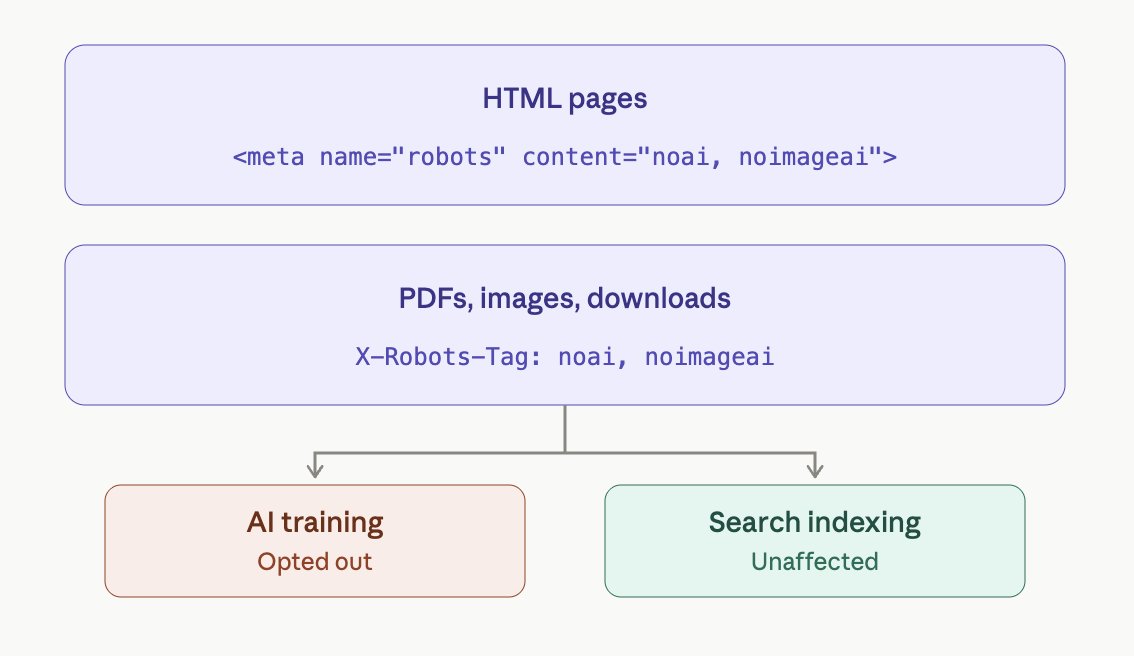
For granular control, meta robots directives let you set policy per page. The noai and noimageai directives signal that compliant systems shouldn't use the page's text or images for AI training, while leaving normal search indexing untouched. For non-HTML assets — PDFs, images, downloadable reports — the same signals travel via the X-Robots-Tag HTTP header. Keep in mind these are emerging conventions honored by compliant crawlers, not universally enforced standards.
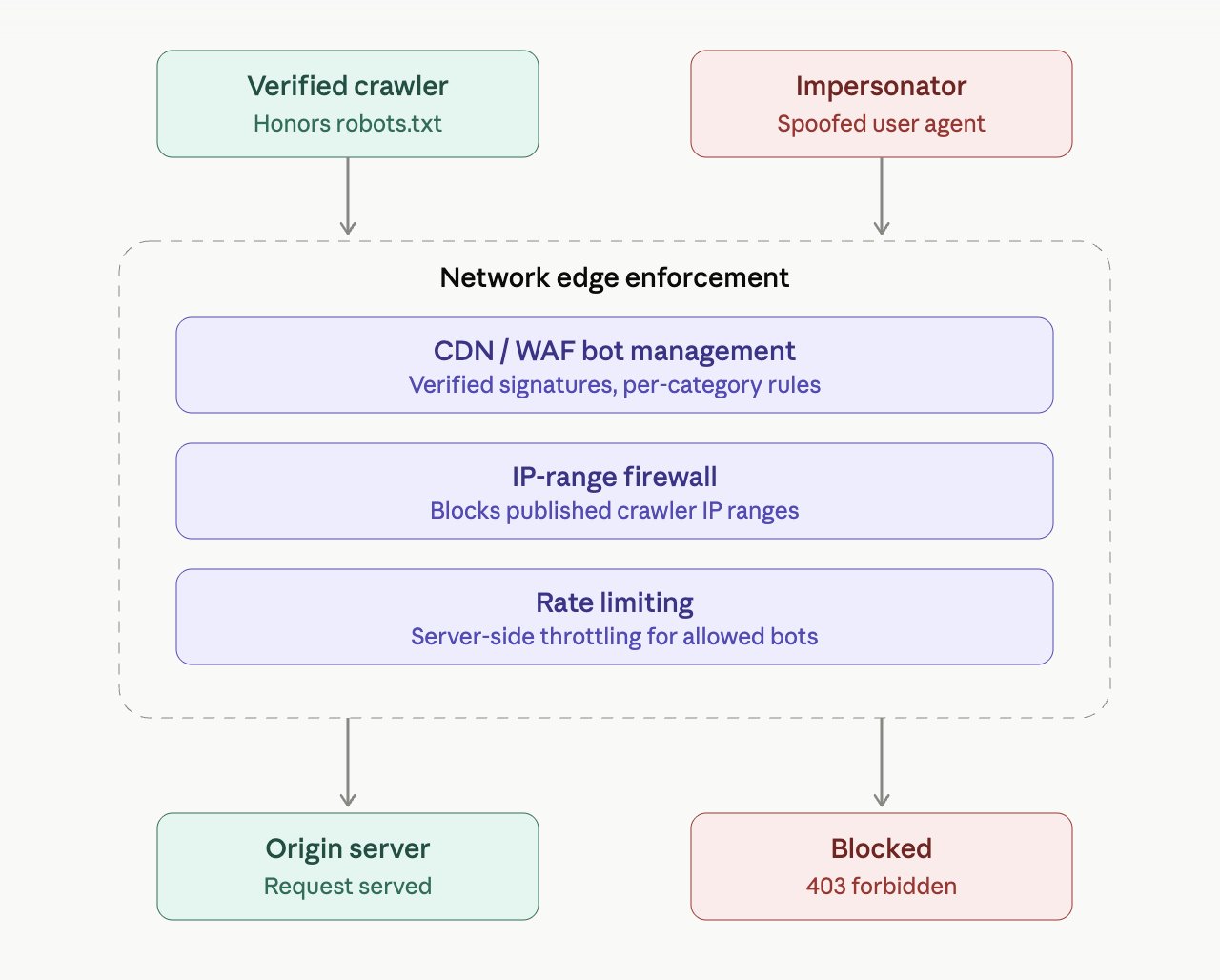
Layer 3: Network-level enforcement — for bots that don't ask permission
Here's the truth every site owner needs to internalize: robots.txt is a request, not a lock. It's a voluntary protocol from 1994 (formalized as RFC 9309 in 2022) with no technical enforcement behind it. TollBit research found that the share of AI bot traffic ignoring robots.txt roughly quadrupled between late 2024 and early 2025, reaching about 13%, with tens of millions of scraping requests bypassing directives in a single month. In one widely covered 2025 dispute, Cloudflare accused crawlers attributed to Perplexity of ignoring robots.txt, rotating IPs, and disguising themselves as Chrome browsers — findings Perplexity disputed, but the episode cemented an industry lesson: verify, don't trust.
When directives fail, enforcement moves down the stack:
- CDN / WAF bot management. Cloudflare's AI Crawl Control (and equivalents) can identify, rate-limit, or block AI crawlers at the network edge using verified bot signatures rather than easily-spoofed user-agent strings.
- IP-range blocking. OpenAI, Anthropic, and Perplexity publish official IP ranges for their crawlers, so firewall rules enforce your policy regardless of whether the bot chooses to comply.
- Rate limiting. Even for bots you allow, throttling protects your infrastructure. Some crawlers (Amazonbot, notably) ignore the Crawl-delay directive, so server-side rate limits are the reliable option.
Layer 4: Emerging standards — signaling rights, not just access
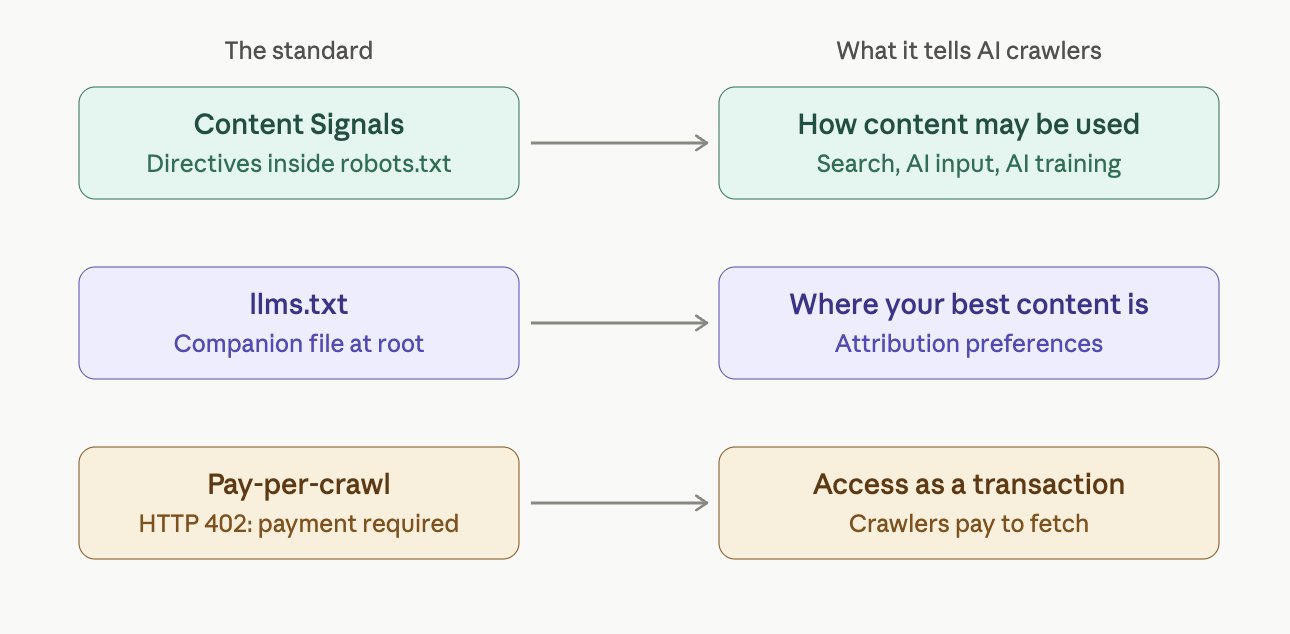
The ecosystem is rapidly building richer machinery than allow/deny. Content Signals are machine-readable directives that live inside robots.txt and express usage preferences — separate signals for search, AI input (retrieval), and AI training. llms.txt is a proposed companion file at your domain root designed to guide AI systems toward your most important content and state attribution preferences; adoption is early, so treat it as a low-cost supplementary signal, not a control mechanism. And pay-per-crawl — Cloudflare's system for responding to AI crawlers with HTTP 402 (Payment Required) — turns crawl access into a licensing transaction. Within weeks of its mid-2026 launch, the network was serving over a billion 402 responses daily, and major platforms like Stack Overflow adopted the model. The conversation is shifting from "block or allow" to "license."
A Practical Decision Framework: Should You Block, Allow, or Mix?
There's no universal right answer — only a right answer for your content economics. Work through these questions:
- Does AI training access hurt you? If your value lies in proprietary research, original data, premium journalism, or expertise that AI models could internalize and repackage, blocking training crawlers protects that asset at essentially zero SEO cost. If you're a business whose blog exists to attract customers, training exposure matters less.
- Does AI search visibility help you? For most businesses, publishers, and creators, the answer is increasingly yes. Blocking retrieval crawlers removes you from that channel entirely. Being cited in an AI answer is the new page-one ranking.
- What does your server data say? Pull your logs before deciding anything. You may discover a crawler consuming enormous bandwidth with zero return — or find that a bot you were about to block barely visits.
The most common strategic configuration in 2026 — and the one robots.txt data across Cloudflare's network shows sophisticated site owners converging on — is exactly the split above: block training, allow retrieval. It keeps your content out of training pipelines while preserving eligibility for AI citations and answers.
One sobering caveat: blocking is not retroactive. If your content was crawled before you added restrictions, it may already live inside trained models. Robots.txt controls future access, not past ingestion.
Does Blocking AI Bots Hurt Your Google Rankings?
No — provided you block the right bots. Search rankings depend on search engine crawlers: Googlebot and Bingbot. AI training crawlers use entirely separate user-agent strings and separate infrastructure. Blocking GPTBot has no bearing on Googlebot. Blocking Google-Extended — despite the Google name — does not touch Google Search, because it's merely a training-permission token layered on top of Googlebot's normal crawling.
The genuine risks are self-inflicted configuration errors:
- Writing an overly broad wildcard rule that accidentally catches Googlebot or Bingbot
- Blocking Bingbot without realizing several AI systems (including some ChatGPT search functionality) have drawn on Bing's index
- Syntax errors that invert your intended rules
Validate every change with a robots.txt testing tool before deploying, and monitor Search Console afterward.
Monitoring: The Step Everyone Skips
A crawl policy without verification is a wish. Build a lightweight monitoring routine:
- Read your server logs, not your analytics. Google Analytics doesn't record bot sessions. Raw access logs are the ground truth; Cloudflare's AI Crawl Control dashboard shows AI bot activity per crawler and per path with no log wrangling at all.
- Verify compliance after changes. Watch logs for 2–4 weeks after adding restrictions. If a blocked bot keeps requesting content, you're looking at either a syntax error or a non-compliant crawler.
- Authenticate suspicious visitors. A user-agent string is just text; anyone can claim to be GPTBot. Cross-check source IPs against the official published ranges.
- Flag unknowns. New AI crawlers routinely appear in the wild before any documentation exists. A quarterly review catches newcomers.
- Watch crawl load. If a single bot accounts for a disproportionate share of requests, rate-limit it regardless of your access policy.
Common Mistakes to Avoid
- Blanket-blocking all AI bots. The nuclear option removes you from AI search and citations even when your only goal was stopping training. Separate the decisions.
- Treating robots.txt as enforcement. It's a published preference. Enforcement lives at the CDN, firewall, and server level.
- Setting and forgetting. The crawler landscape reorders itself monthly. A robots.txt written in 2024 doesn't mention half the bots active today.
- Ignoring the extended tokens. Many sites block GPTBot but never add Google-Extended or Applebot-Extended.
- Never documenting rationale. Undocumented rules get accidentally deleted or misunderstood by the next person who touches the file.
- Assuming allowed = cited. Crawl access makes you eligible for AI answers; it doesn't guarantee selection. Access is the ticket to the arena — content quality wins the fight.
The Bottom Line
AI bots can crawl your website, they almost certainly already are, and doing nothing is itself a decision — one that donates your content to training pipelines while capturing none of the upside.
The good news is that control has never been more granular. Because training crawlers, retrieval crawlers, and user agents all identify separately, you can craft a policy as nuanced as your content strategy demands: shield your proprietary work from training datasets, stay fully visible in AI search and citations, keep your Google rankings untouched, and enforce it all at the network level when polite requests aren't honored.
Start with three actions this week: pull your server logs to see who's actually crawling you, deploy a commented robots.txt that separates training from retrieval policy, and set a calendar reminder to verify compliance in 30 days. The websites that thrive in the AI era won't be the ones that hid from it or surrendered to it — they'll be the ones that managed it deliberately.
Frequently Asked Questions
Can I stop AI companies from using content they already crawled?
Not through technical controls. Robots.txt and blocking prevent future crawling; they don't reach into existing training datasets or trained models. Removing already-ingested content is a legal and policy question, currently being tested in courts and shaped by regulation such as the EU AI Act's transparency and opt-out provisions.
Do all AI bots identify themselves honestly?
No. Documented crawlers from major platforms use consistent user-agent strings, but researchers have repeatedly observed scrapers impersonating browsers or rotating identities. This is exactly why server-log monitoring and IP verification matter.
Is there any benefit to allowing training crawlers?
Possibly. Content absorbed into a model shapes how that model discusses your topic, brand, and industry — a kind of ambient influence some brands value. The trade-off is that this influence comes without attribution or traffic. For most publishers whose business depends on being read, the exchange currently favors blocking training while courting retrieval.
How often should I review my AI crawl policy?
Quarterly at minimum. Review server logs for new user agents, check for newly documented crawlers from major platforms, re-validate robots.txt syntax, and confirm blocked bots have actually stopped.
Will AI crawling replace traditional SEO?
It's reshaping it rather than replacing it. Traditional search still drives the overwhelming majority of referral traffic, but AI answers increasingly intercept informational queries. The durable strategy is to remain excellent at both: strong classic SEO fundamentals and deliberate AI crawl and visibility management.
Harsh Jangid is a Co-founder at Coozmoo — the #1 rated AI-powered, data-driven digital marketing agency built to skyrocket revenue for small and medium-sized businesses — and a driving force behind RankRabbit.ai, Coozmoo's proprietary AI-powered growth platform.
He leads growth, brand, and go-to-market at Coozmoo, translating deep customer insight into positioning, product, and campaigns that consistently outperform traditional agency playbooks. Under his leadership, RankRabbit.ai has become the visibility engine SMBs use to dominate both traditional search and the next generation of AI-powered discovery platforms — ChatGPT, Perplexity, Gemini, and beyond.
Harsh combines commercial instinct with an operator's discipline, obsessed with the specific question every founder actually cares about: is this moving revenue? That focus shapes everything RankRabbit ships — from Search AI and Listing AI to Social AI and Reputation AI.
Ready to capture high-intent buyers?
See how RankRabbit helps your business rank everywhere — and win where it actually counts.