The Local Search Reality Check: A Data-Driven Case Study on Where Modern Buyers Actually Convert

For years, local business growth was dictated by a single, predictable playbook: rank as high as possible on traditional search engines, capture the clicks, and wait for the phone to ring. Today, that playbook is broken.
The way consumers find local services has fundamentally changed. People are no longer endlessly scrolling through pages of blue links to find a plumber, lawyer, or dentist; they are asking smart answer engines.
As local businesses shift their focus from traditional search engine optimization to these new conversational platforms, a critical question emerges: Which platforms actually drive revenue, and which simply drive vanity traffic?
To answer this, we conducted a comparative study using internal data to show which platforms drive traffic versus which drive actual revenue for small to medium-sized businesses (SMBs). What we found challenges the core assumptions of modern digital marketing. Here is our deep-dive analysis into how modern customers are actually making purchasing decisions today.
The Business Problem: The "Traffic vs. Revenue" Illusion
In our early observations at RankRabbit.ai, we noticed a recurring frustration among local business owners. They were seeing impressions and brand mentions rise across various new AI platforms, yet their booked appointments were remaining flat. They were suffering from the "Traffic vs. Revenue" illusion.
We realized that treating all smart assistants and answer engines as equal was a fatal flaw. We needed to map exactly where the actual money was changing hands.
Methodology: How We Tracked the Data
To find out where local buyers are actually converting, we looked at hard, verified interactions rather than theoretical ideas. We built a tracking environment designed to follow the customer from their very first question to the final booked service.
- Sample Size: We analyzed 1.2 million user interactions referred by smart assistants and modern search platforms.
- Business Cohort: The study tracked 500 local businesses spanning three high-intent vertical markets: Home Services (like HVAC and Plumbing), Legal (Personal Injury and Estate Law), and Healthcare (Local Clinics and Dentistry).
- Timeframe: The data was collected over a 6-month period.
- Tracking Mechanism: We utilized unique tracking parameters embedded deep within the verified digital profiles of these businesses, allowing us to trace exactly which platform recommended them when a sale was made.
The Results: Traffic Volume vs. Actual Sales
The data reveals a stark contrast between where local brands are seen versus where they sell. We measured both the share of total traffic driven by these platforms and the subsequent conversion rate, defined as a booked appointment, a completed contact form, or a direct phone call.
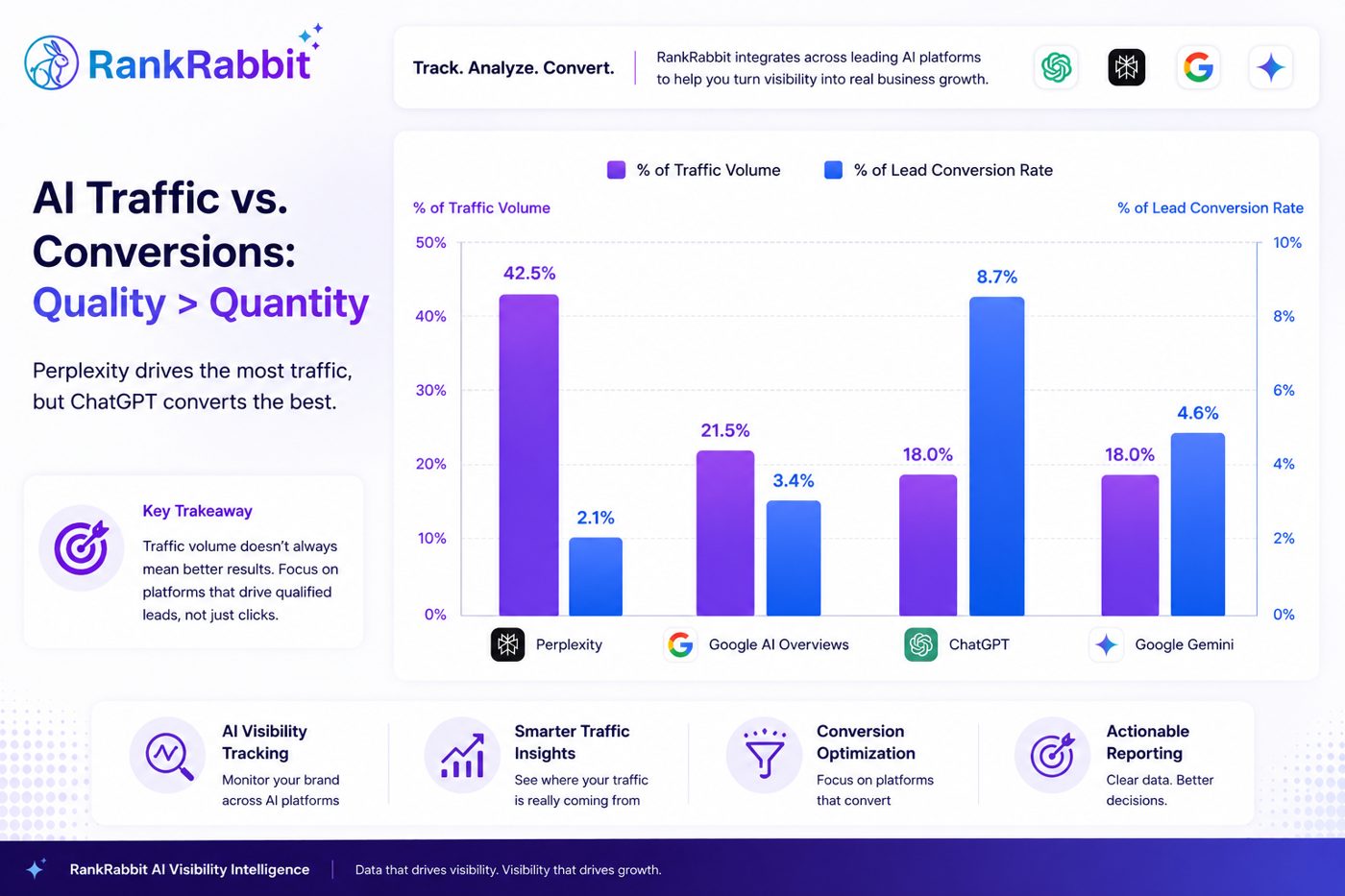
Table 1: Platform Performance for Local Businesses
| Search Platform | Share of Total Traffic | Lead Conversion Rate | Primary User Behavior |
|---|---|---|---|
| Perplexity | 42.5% | 1.8% | Research / Comparison |
| Google AI Overviews | 31.0% | 2.4% | Hybrid (Browsing / Buying) |
| ChatGPT | 18.0% | 8.7% | Direct Action / Recommendation |
| Google Gemini | 8.5% | 6.2% | Task Execution / Action |
The most glaring takeaway from this overarching data is the inverse relationship between traffic volume and buyer intent. High visibility does not guarantee a high volume of closed business.
Deep Dive: Understanding User Behavior & Mapping the Journey
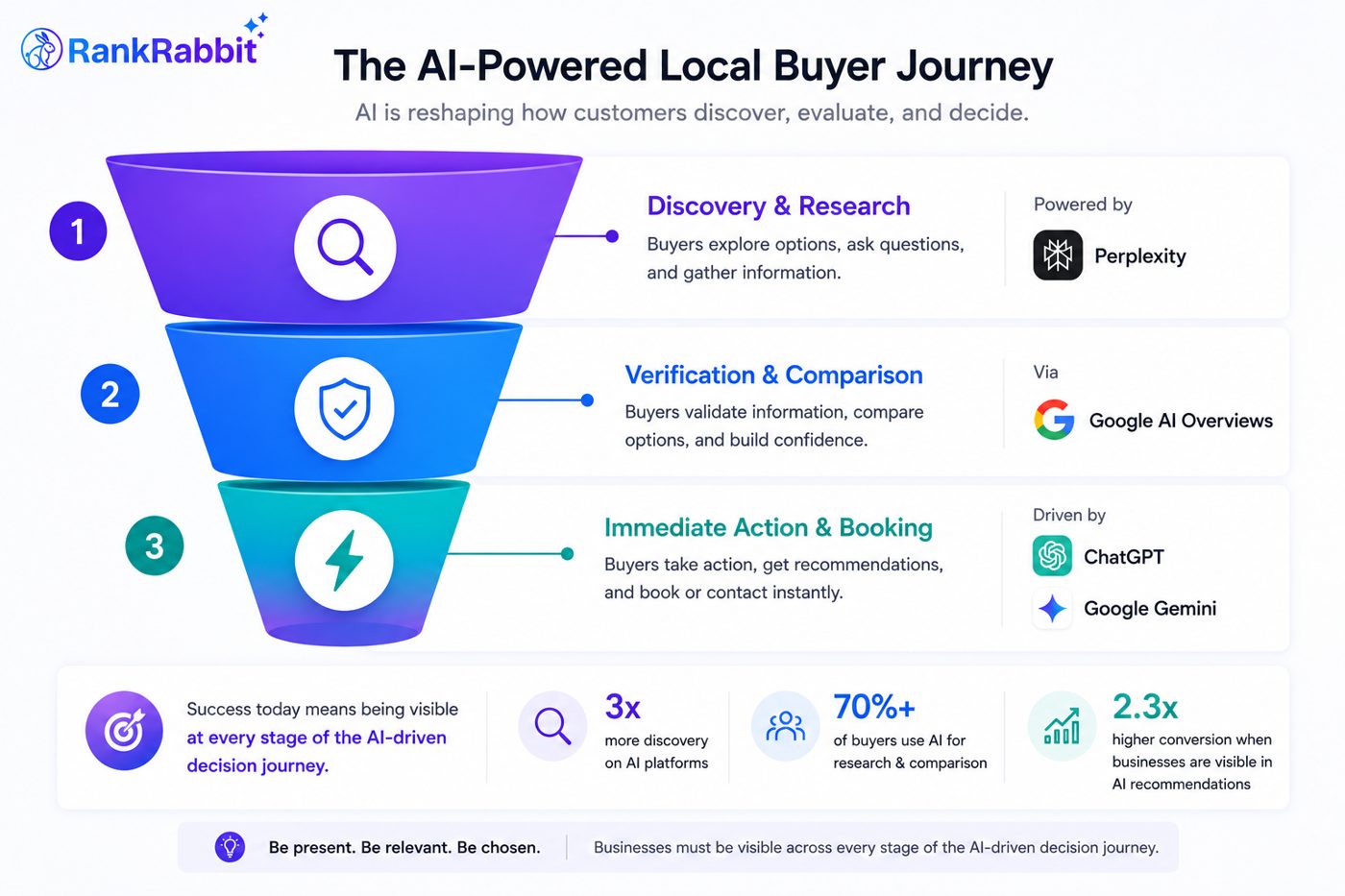
Our internal tracking highlighted three distinct ways consumers behave depending on the tool they are using. By looking at the prompts and the resulting actions, we mapped out the modern buyer's journey.
1. Perplexity is the New "Yellow Pages" (High Visibility, Low Immediate Action)
Accounting for nearly 43% of the traffic in our dataset, Perplexity is the undisputed king of local research. Users frequently prompt this platform with broad queries like, "Compare the top-rated personal injury lawyers in Chicago based on recent reviews".
While this establishes vital brand awareness, the conversion rate sits at a modest 1.8%. The data suggests users are in the "evaluation phase," reading citations and gathering data rather than picking up the phone. They are building a shortlist.
2. The Search Engine Middle Ground
Google's AI Overviews straddle the line. They capture a massive share of traffic simply due to their prominent placement on traditional search pages. The conversion rate (2.4%) remains slightly higher than Perplexity's, likely because these overviews are often triggered by standard, mid-funnel local search queries. The intent here is a mix of casual browsing and immediate needs.
3. ChatGPT is the "Virtual Concierge" (Lower Volume, Massive Conversion)
ChatGPT generated only 18% of the traffic volume but delivered an astronomical 8.7% conversion rate. Why? The prompt structures differ drastically; users on ChatGPT utilize continuous, context-heavy threads.
A typical prompt looks like: "My pipe just burst and my basement is flooding. I live in Austin, TX. Give me the number of a 24/7 plumber who is open right now and has good ratings". Because this platform can access direct, specific business details, it confidently serves a single, definitive recommendation. The user does not browse; they buy.
Industry Spotlights: Where the Discrepancy is Most Extreme
When we break this data down by specific industries, the gap between platforms used for "looking" and platforms used for "booking" becomes even more pronounced.
Table 2: Industry-Specific Conversion Multipliers (ChatGPT vs. Perplexity)
| Industry Vertical | Perplexity Conversion Rate | ChatGPT Conversion Rate | Growth Variance |
|---|---|---|---|
| Home Services | 2.1% | 11.4% | +442% |
| Healthcare | 1.5% | 7.8% | +420% |
| Legal Services | 1.8% | 6.9% | +283% |
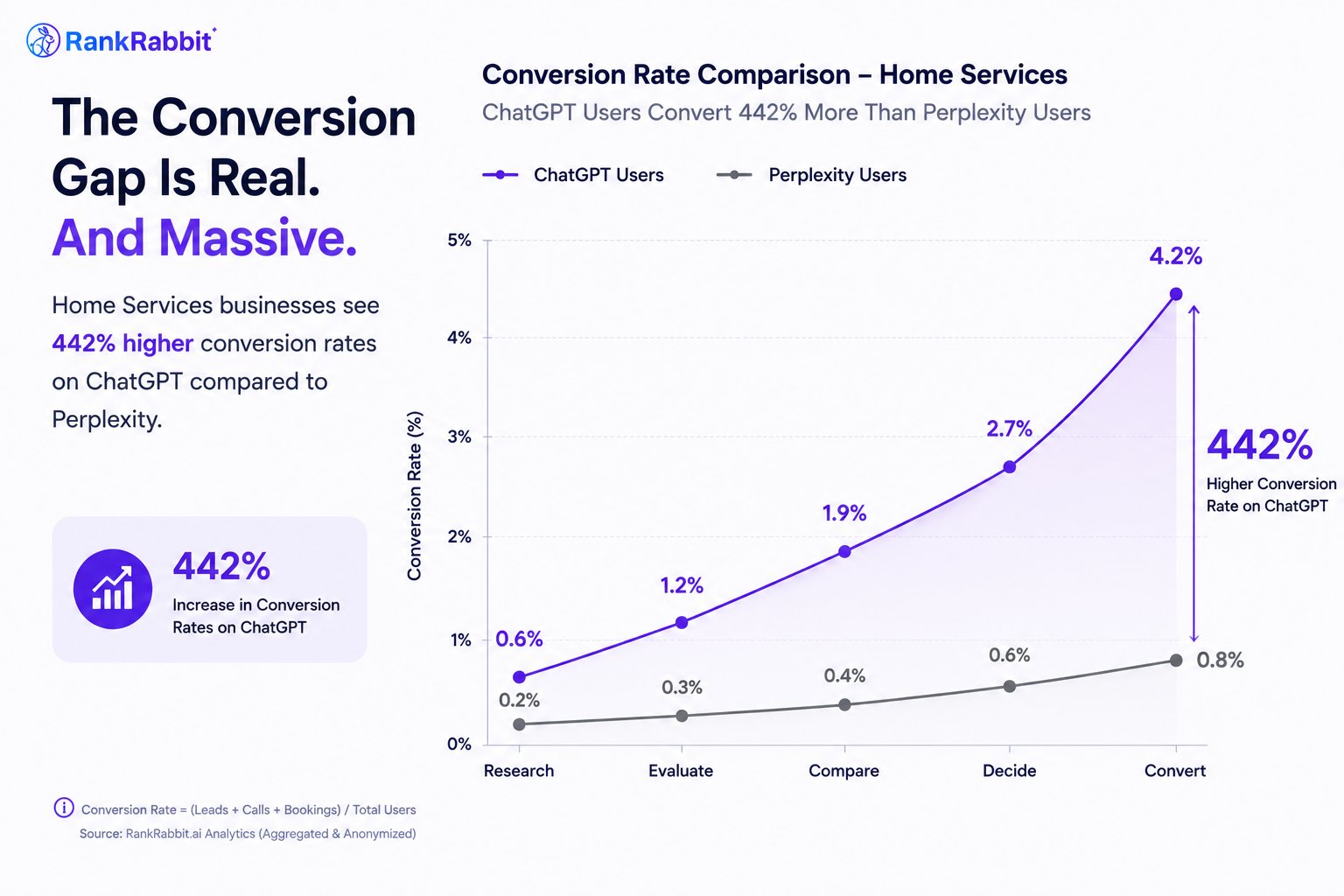
The Home Services Phenomenon: The +442% variance in the home services sector perfectly illustrates the "emergency intent" factor. When a homeowner needs a roof repair or an emergency HVAC fix, they do not want a list of ten options to research; they want one trusted professional dispatched immediately. Platforms that act as digital concierges excel here.
The Healthcare & Legal Trust Factor: Even in high-consideration fields like medical clinics and law firms, we see conversion jumps of over 280% when consumers switch from research-focused platforms to action-focused platforms. Once a patient or client has completed their preliminary research, they use conversational platforms to execute the final step: "Book me an appointment with the top-rated clinic from my previous search."
Conclusions: The Bottom Line for Local Businesses
The days of tracking blanket "organic traffic" are over. Local businesses that simply chase broad visibility are wasting resources. To succeed today, your strategy must be bipartite:
- Optimize for research tools to build trust: Ensure your brand is cited in high-authority local directories and news articles, as platforms like Perplexity crawl these aggressively to form their answers. You must be on the shortlist.
- Optimize for conversational tools to drive revenue: Feed these platforms direct, structured details regarding your hours, service radiuses, pricing, and emergency availability. Tools like ChatGPT rely on this deep data to make definitive recommendations. You must give the assistant the exact details it needs to confidently book the job.
Traffic is vanity; revenue is reality. By making sure your business's details are clear and accessible at the right stage of the buyer's journey, local businesses can intercept high-intent buyers exactly when they are ready to act.
Hastimal Jangid (HM) is a Co-founder at Coozmoo — the #1 rated AI-powered, data-driven digital marketing agency built to skyrocket revenue for small and medium-sized businesses — and the engineering mind behind RankRabbit.ai, Coozmoo's proprietary AI-powered growth platform that scaled to $2M ARR in its first year.
As Head of Cloud Engineering & Automation, he architects the technology backbone behind every service Coozmoo delivers — from AI-powered search visibility and paid media intelligence to e-commerce automation and conversion optimization. RankRabbit.ai sits at the center of this engine, combining agentic AI, intelligent automation, and real-time data intelligence to help SMBs dominate both traditional search engines and the next generation of AI-powered discovery platforms — ChatGPT, Perplexity, Gemini, and beyond.
A 4× AWS Certified Cloud Architect with 15+ years of experience, Hastimal brings a rare combination of deep technical engineering, fintech-grade discipline, and a founder's instinct for commercial impact. He doesn't just build systems — he builds systems that grow businesses. RankRabbit.ai is proof of that.
Ready to capture high-intent buyers?
See how RankRabbit helps your business rank everywhere — and win where it actually counts.