Why Do Multi-Location Businesses Lose 40% of Their Visibility to Listing Errors?

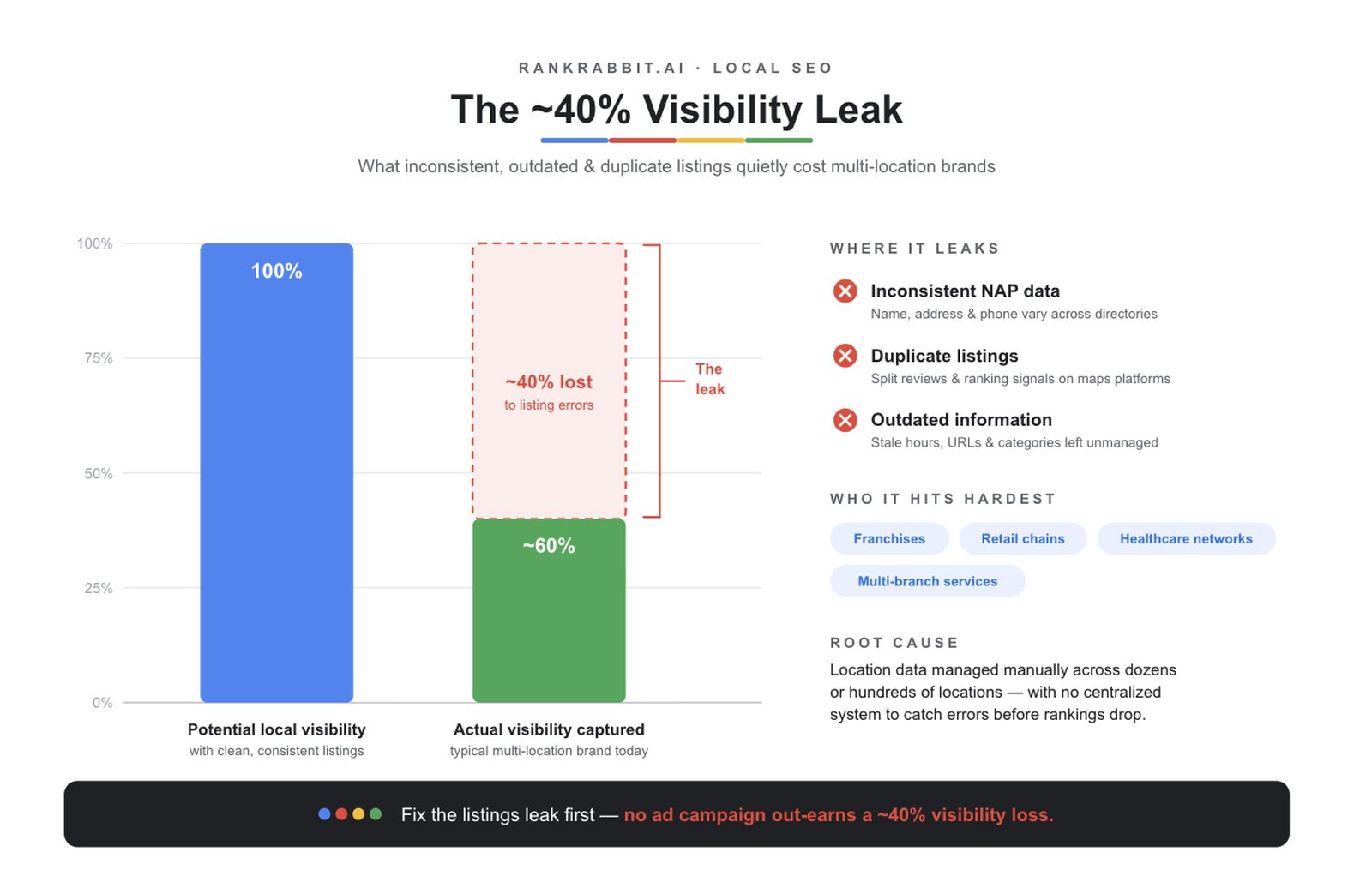
Multi-location businesses lose close to 40% of their potential local search visibility because of inconsistent, outdated, or duplicate business listings across directories, map platforms, and search engines. This happens because most brands manage location data manually, across dozens or hundreds of locations, with no centralized system to catch errors before they hurt rankings.
If you run a multi-location brand, a franchise, a retail chain, a healthcare network, or a service business with several branches, this single issue is probably costing you more customers than any ad campaign could bring in. Let's break down exactly why this happens, what it costs you, and how to fix it permanently.
What Counts as a "Listing Error" for a Multi-Location Business?
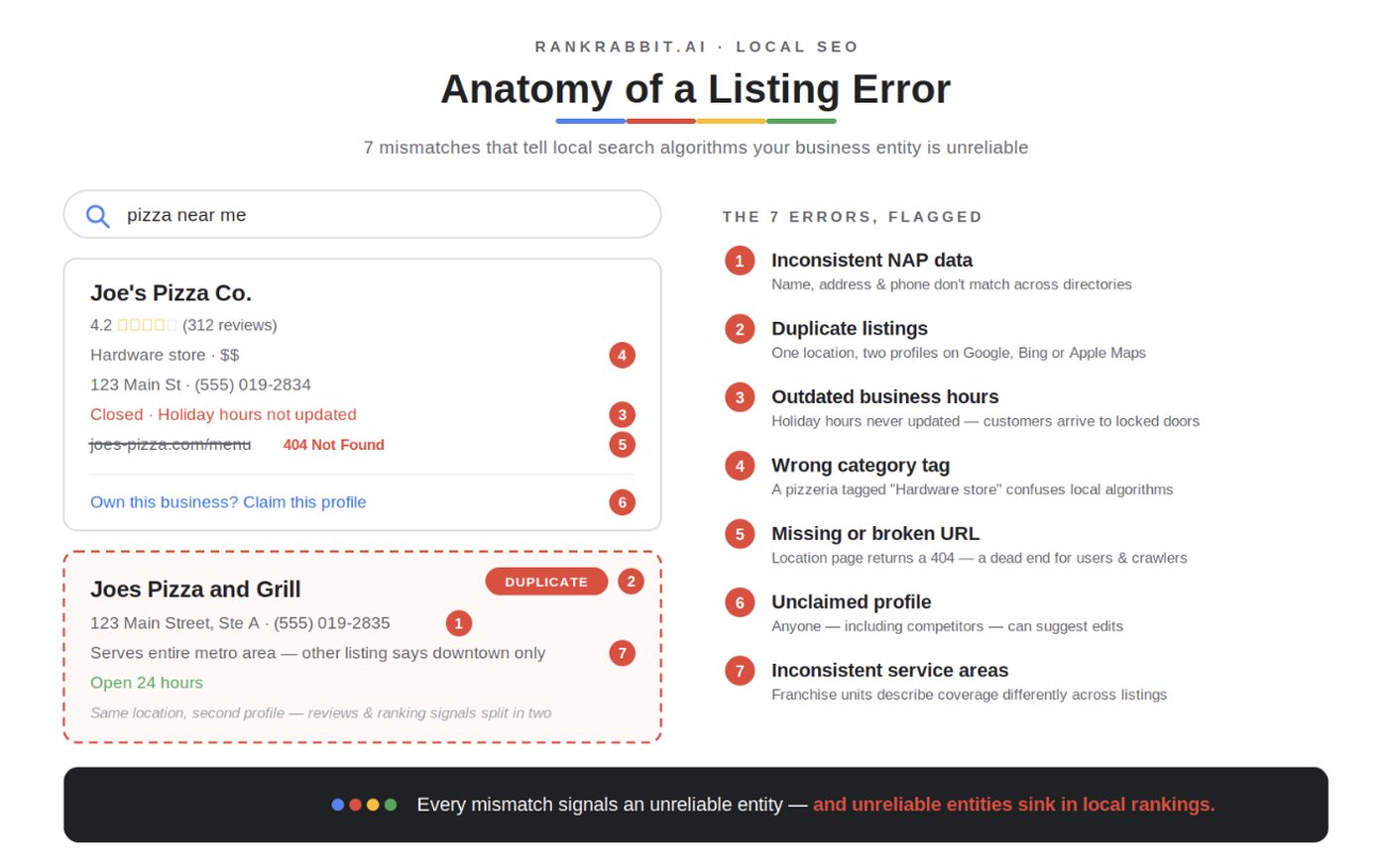
A listing error is any mismatch between how your business information appears online and how it actually exists in reality. This includes:
- Inconsistent NAP data (Name, Address, Phone number) across directories
- Duplicate listings for the same location on Google Business Profile, Bing Places, or Apple Maps
- Outdated business hours, especially around holidays
- Wrong category tags that confuse local search algorithms
- Missing or broken website URLs on individual location listings
- Unclaimed or unverified listings competitors can edit
- Inconsistent service area or location descriptions across franchise units
Each of these signals to search engines that your business entity is unreliable, and unreliable entities get pushed down in local rankings.
Why Does Listing Data Break Down Specifically at Scale?
Listing data breaks down at scale because every location adds a new point of failure, and most businesses don't have a system built to manage that complexity. A single-location business might have five or six directory listings to monitor. A 200-location chain has potentially 10,000+ listing instances across search engines, map apps, review platforms, and niche directories.
Common root causes include:
- Manual data entry — Franchise owners or regional managers update listings independently, introducing inconsistencies.
- Aggregator data lag — Directories pull data from third-party aggregators that sync infrequently, so old information persists even after corrections.
- Ownership confusion — Multiple people across corporate and franchise levels claim the same Google Business Profile, causing conflicting edits.
- Location changes — Openings, closings, rebrands, or address changes don't get pushed to every platform simultaneously.
- No centralized monitoring — Without a single dashboard, errors go unnoticed for months.
How Does a Listing Error Actually Cause Search Engines to Hide Your Business?
Search engines suppress or demote listings when they detect inconsistency because inconsistency signals low trustworthiness in their entity recognition models. Google, Bing, and Apple Maps all build an internal "entity profile" of your business based on how consistently your NAP data appears across the web.
When your entity signals conflict — for example, your website says "Suite 200" but Google Business Profile says "Suite 2" — the algorithm can't confidently confirm your business is the same entity in both places. This creates three visibility problems:
- Local Pack suppression — Your business drops out of the map 3-pack for relevant searches.
- Duplicate listing dilution — Review counts and ranking signals split across two listings instead of consolidating into one strong profile.
- Reduced "proximity trust" — Search engines hesitate to show your business for "near me" searches when data conflicts exist.
This is why the 40% figure isn't an exaggeration — it reflects real ranking and click-through loss measured across multi-location local SEO audits.
Why Does Google Treat Each Location as a Separate Trust Problem?
Google doesn't evaluate a multi-location brand as one unified entity — it evaluates each physical location as its own local ranking candidate, competing individually in its own geographic radius. This means your flagship location in one city and your newest branch in another are judged entirely on their own merits, based on their own listing accuracy, review velocity, and citation consistency.
This creates a compounding problem for growing businesses. A brand with strong national recognition can still perform poorly at the local level if individual location data hasn't been verified, updated, or consolidated properly. Corporate brand equity does not transfer automatically to local search equity — each location has to earn its own trust signals, and listing errors are the fastest way to lose that trust before it's even built.
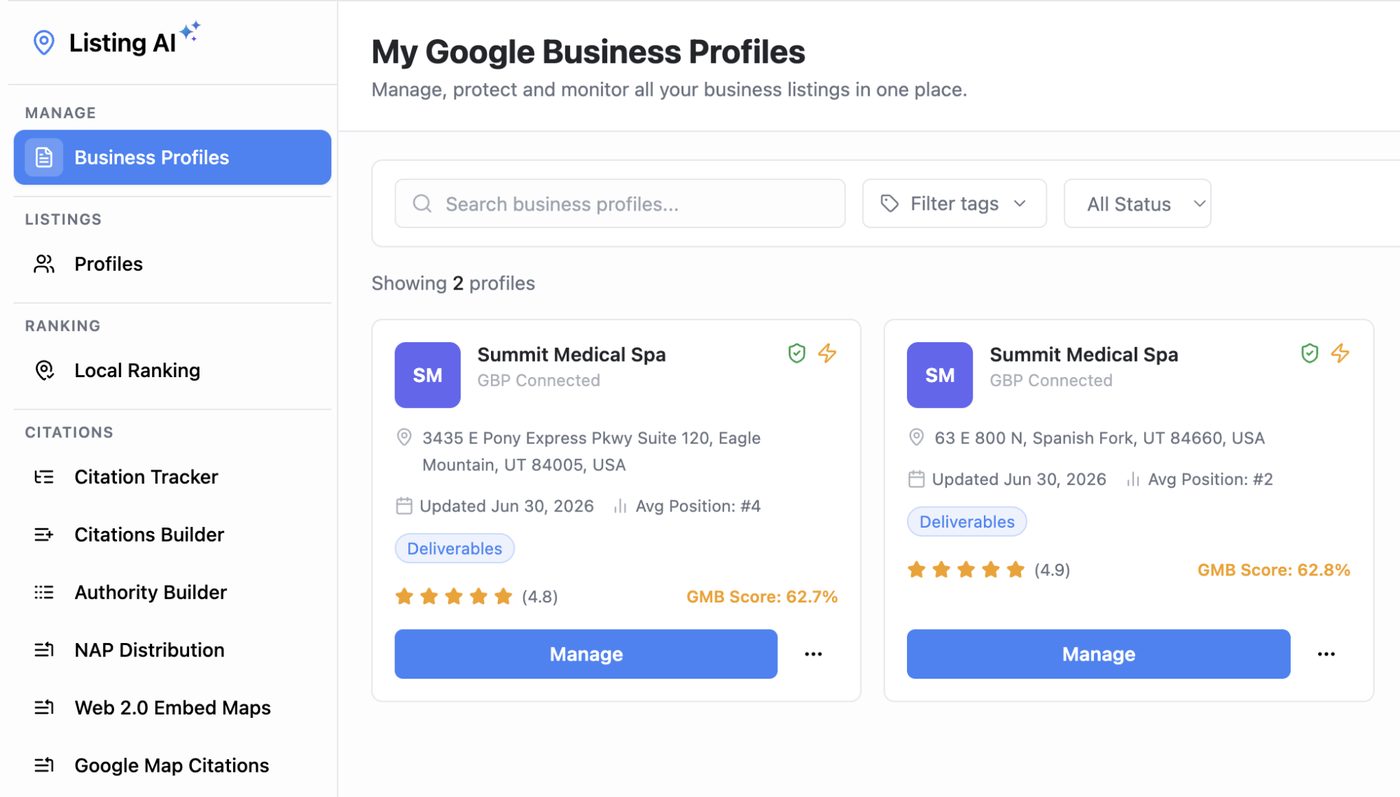
This is also why franchise businesses often see wildly inconsistent performance between locations. Two branches with identical service quality can rank completely differently in local search simply because one has clean, consistent listing data and the other doesn't.
How Do Duplicate Listings Specifically Sabotage Rankings?
Duplicate listings are one of the most damaging — and most common — listing errors for multi-location businesses, and they hurt rankings in a way that's easy to underestimate. When a location has two active profiles on the same platform (often created when a franchise owner and a corporate team both set up a Google Business Profile independently), the ranking authority that should belong to one strong listing gets split across two weaker ones.
Here's what that split actually does:
- Reviews get divided — Instead of 150 reviews on one profile signaling strong trust, you might have 90 reviews on one duplicate and 60 on another, both looking less authoritative than a consolidated 150.
- Click data fragments — Search engines use engagement signals like clicks and calls to reinforce ranking; fragmented listings dilute this data across two profiles instead of strengthening one.
- Confusion at the user level — Customers who find two listings with slightly different hours or phone numbers often assume one is fake, abandoning the search entirely.
- Suppression risk — Google's algorithm sometimes proactively suppresses both duplicate listings until the conflict is resolved, meaning the business shows up nowhere in the map pack until it's fixed.
Duplicate listings rarely get flagged by business owners themselves — they're usually only discovered during a dedicated audit, which is part of why this issue silently persists for years in many multi-location brands.
What Role Do Data Aggregators Play in Making This Worse?
Data aggregators are third-party companies (like Data Axle, Foursquare, and Neustar Localeze) that collect business information and redistribute it to hundreds of directories, apps, and search platforms. Many business owners don't realize that correcting a listing directly on Google or Yelp doesn't always fix the underlying problem — if an aggregator has outdated information in its database, it can push the old, incorrect data right back out across the web weeks or months later.
This creates a frustrating cycle:
- A location manager corrects an address on Google Business Profile.
- An aggregator's outdated record syncs to a smaller directory a few weeks later.
- That smaller directory's data gets picked up by Google's crawlers as a "consistency check."
- Google sees conflicting information again and quietly reduces confidence in the listing's accuracy.
For a single-location business, this is a manageable nuisance. For a business with 100+ locations, it means this cycle is happening simultaneously across dozens of aggregator relationships, making manual correction nearly impossible to keep up with without a dedicated monitoring system.
Which Industries Are Most Affected by This Problem?
Businesses with high location density and frequent operational changes are hit hardest. This includes:
| Industry | Common Listing Error | Visibility Impact |
|---|---|---|
| Franchise & Retail Chains | Duplicate GBP listings per location | Local Pack suppression |
| Healthcare & Multi-Clinic Networks | Inconsistent provider vs. location NAP | Patient search drop-off |
| Auto & Home Services | Wrong service area radius | Missed "near me" searches |
| Restaurants & Hospitality | Outdated hours/holiday hours | Lost walk-in traffic |
| Real Estate & Legal Offices | Suite/address mismatches | Reduced map pack ranking |
| E-commerce with Physical Stores | Inconsistent store locator data | Lower local + organic visibility |
What Does This Actually Cost a Business in Real Terms?
Listing errors cost businesses in three measurable ways:
- Lost local pack rankings → fewer clicks, calls, and directions requests
- Lower conversion trust → customers who find conflicting info often choose a competitor instead
- Wasted ad spend → paid campaigns driving traffic to listings that don't rank organically waste budget compensating for a fixable problem
For a business with 50+ locations, even a 20-30% drop in local visibility can translate into thousands of lost monthly leads, often invisible until a proper audit is done.
How Can a Business Tell If Listing Errors Are Already Hurting Them?
Most multi-location businesses don't realize they have a listing problem until they actively look for it, because the symptoms often get misattributed to other causes. Some of the clearest warning signs include:
- Inconsistent performance between similar locations — If two locations with comparable size, service quality, and review counts are ranking very differently in local search, listing inconsistency is one of the first things worth investigating.
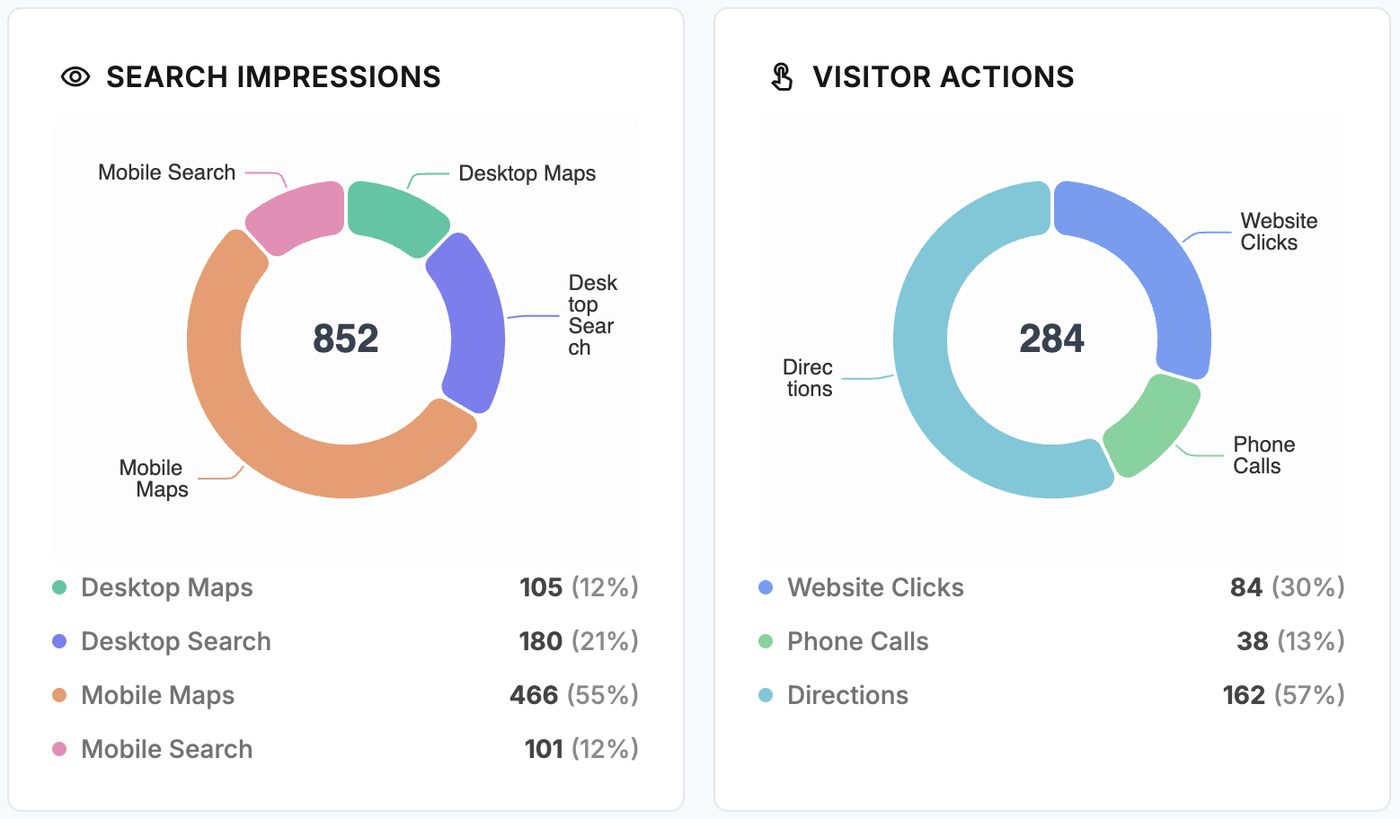
- Declining impressions in Google Business Profile insights — A steady drop in map views or search appearances, especially without a clear operational cause, often points to a trust or consistency issue.
- Customer complaints about wrong hours or addresses — If customers mention arriving to find different hours than what they saw online, that's a direct signal of unresolved listing conflicts.
- Unclaimed or "suggested edit" notifications — Platforms like Google will sometimes flag a listing as needing verification when third parties suggest changes, which is often a sign no one on the internal team is actively monitoring that profile.
- Multiple internal teams managing the same location — If corporate marketing, regional managers, and individual franchisees all have edit access to the same listings without coordination, errors are almost guaranteed over time.
A simple way to check this is to search your own brand name plus each city you operate in, and compare what appears across Google, Bing, and Apple Maps for each location. Even a quick manual spot-check across 5-10 locations often reveals inconsistencies that have gone unnoticed for months.
What Does a Realistic Example of This Problem Look Like?
Consider a mid-sized home services franchise with 60 locations across three states. Corporate marketing originally set up Google Business Profiles for all 60 locations at launch. Over the following two years:
- 12 franchise owners independently claimed or re-created their own profiles, creating duplicates.
- 8 locations changed addresses or suite numbers due to lease changes, but only updated their website, not their Google, Bing, or Yelp listings.
- 15 locations had inconsistent service category tags, with some listed as "Plumber" and others as "Home Services" for identical service offerings.
- Holiday hours were manually updated by individual staff at only 20 of the 60 locations each year, leaving the rest showing incorrect hours during high-search periods like long weekends.
When this business finally ran a full listing audit, it found that roughly 35-40% of its locations had at least one significant listing inconsistency actively suppressing local visibility — almost exactly matching the industry-wide pattern this article opened with. After cleaning up duplicates, standardizing categories, and centralizing hour updates, the business saw a measurable increase in map pack appearances and "near me" search visibility within a few weeks, without any change to ad spend or website content.
This is a common pattern: the fix isn't more marketing spend — it's data hygiene at scale.
How Can Multi-Location Businesses Fix and Prevent Listing Errors?
Fixing this requires moving from manual, location-by-location management to a centralized, automated system. The core steps are:
- Audit every listing across all platforms — not just Google, but Bing, Apple Maps, Yelp, and niche directories.
- Standardize your NAP format company-wide before making any updates.
- Claim and verify every location profile to prevent competitor or third-party edits.
- Automate updates so hours, addresses, and details sync instantly across all platforms when they change.
- Monitor continuously — listing drift happens constantly, so a one-time cleanup isn't enough.
Doing this manually across dozens or hundreds of locations is where most internal teams get stuck — which is exactly the gap Listing AI was built to close.
How Does Listing AI by RankRabbit Solve This at Scale?
Listing AI is built specifically for multi-location businesses that need accurate, consistent listing data across every platform without manual, location-by-location work. It handles the entire lifecycle of listing management:
- Automated NAP consistency checks across every location, flagging mismatches instantly
- Duplicate listing detection and cleanup so ranking signals consolidate into one strong profile per location
- Real-time syncing of hours, addresses, and categories across major directories and map platforms
- Ownership and verification management to prevent unauthorized edits
- Continuous monitoring so new errors are caught the moment they appear, not months later
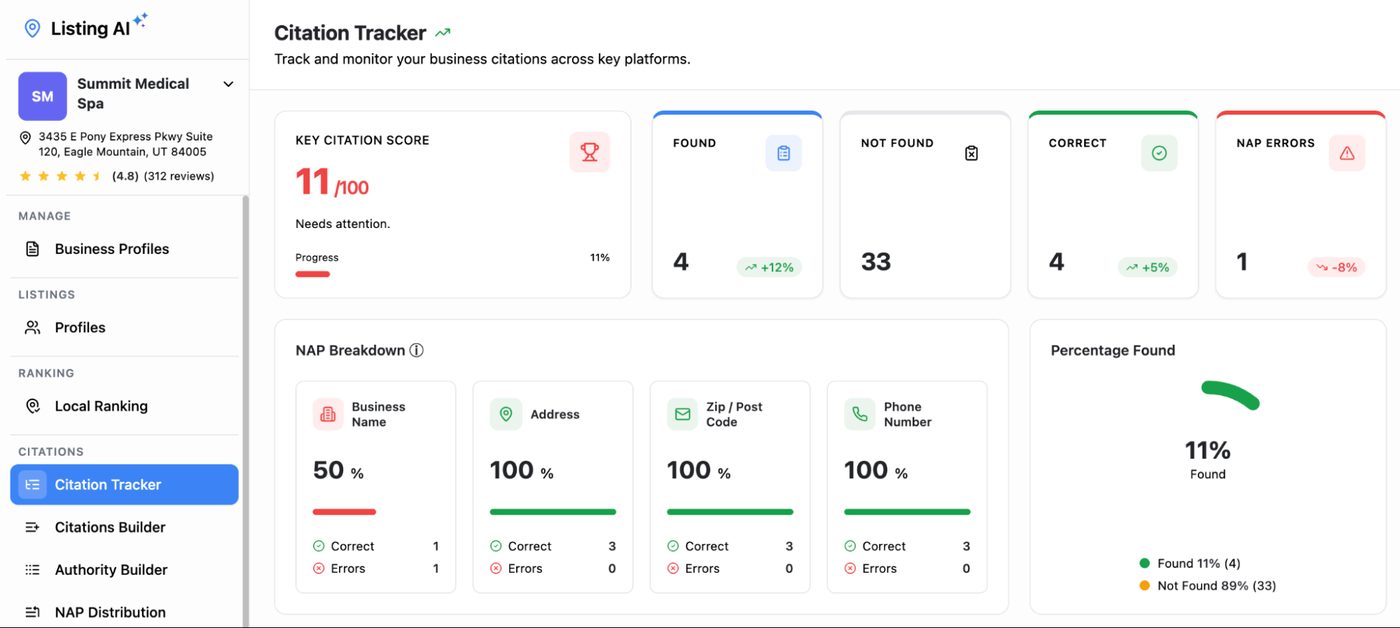
Instead of losing visibility to preventable data errors, multi-location brands using Listing AI keep every location's entity profile clean, consistent, and trusted by search engines — which directly protects and improves local rankings.
Final Thoughts
Listing errors are one of the most preventable yet most damaging issues in local SEO, especially for multi-location businesses where the problem multiplies at scale. The good news is that this isn't a ranking algorithm mystery to solve; it's a data consistency problem with a clear fix.
If your business operates across multiple locations and you suspect listing errors might be quietly costing you visibility, the smartest move is to centralize and automate the process rather than chase it manually.
Listing AI by RankRabbit was built exactly for this — helping multi-location brands protect their local search visibility by keeping every listing accurate, consistent, and search-engine trusted, automatically.
FAQs
1. What is a listing error in local SEO?
A listing error is any mismatch between your business information online and reality — inconsistent NAP data (name, address, phone), duplicate profiles, outdated hours, wrong categories, broken URLs, or unclaimed listings. Each inconsistency signals to search engines that your business entity is unreliable, which suppresses your local rankings.
2. How do listing errors cause a business to lose local search visibility?
Search engines cross-reference your business data across directories, map platforms, and review sites to verify your entity. When the data conflicts, the algorithm loses confidence in which version is true and ranks you lower in local packs and map results — meaning fewer impressions, fewer calls, and fewer direction requests, regardless of how good your service is.
3. Why are multi-location businesses more affected by listing errors than single-location ones?
Errors compound with scale. A single-location business manages one set of listings; a 50-location brand manages thousands of data points across Google Business Profile, Bing Places, Apple Maps, and dozens of directories. Managed manually, every rebrand, relocation, phone change, or holiday schedule multiplies the chance of inconsistency across the network.
4. What is NAP consistency and why does it matter?
NAP stands for Name, Address, and Phone number — the core identity signals search engines use to confirm your business entity. Even small variations ("St." vs "Street," an old tracking number, "Joe's" vs "Joes") can fragment your entity signals across the web. Consistent NAP data is one of the foundational trust factors in local ranking algorithms.
5. How do duplicate Google Business Profile listings hurt rankings?
Duplicates split your ranking signals in two: reviews, photos, engagement, and citations get divided between profiles instead of strengthening one. Google may also suspend or filter listings it detects as duplicates. The result is that neither profile ranks as well as a single consolidated listing would.
6. How do I find and fix listing errors across all my locations?
Start with an audit: export every location's data into one source of truth, then check each location's presence on Google Business Profile, Bing Places, Apple Maps, and major directories against it. Fix the highest-impact issues first — duplicates and NAP mismatches — then outdated hours, categories, and URLs. For more than a handful of locations, a centralized listing management system is the only sustainable way to keep data synced.
7. How often should multi-location businesses audit their listings?
Quarterly at minimum, plus immediately after any trigger event: a rebrand, relocation, phone system change, new opening or closure, and before every major holiday season. Since anyone can suggest edits to Google listings — and Google sometimes applies them automatically — unmonitored profiles can drift out of date even when you've changed nothing.
Hastimal Jangid (HM) is a Co-founder at Coozmoo — the #1 rated AI-powered, data-driven digital marketing agency built to skyrocket revenue for small and medium-sized businesses — and the engineering mind behind RankRabbit.ai, Coozmoo's proprietary AI-powered growth platform that scaled to $2M ARR in its first year.
As Head of Cloud Engineering & Automation, he architects the technology backbone behind every service Coozmoo delivers — from AI-powered search visibility and paid media intelligence to e-commerce automation and conversion optimization. RankRabbit.ai sits at the center of this engine, combining agentic AI, intelligent automation, and real-time data intelligence to help SMBs dominate both traditional search engines and the next generation of AI-powered discovery platforms — ChatGPT, Perplexity, Gemini, and beyond.
A 4× AWS Certified Cloud Architect with 15+ years of experience, Hastimal brings a rare combination of deep technical engineering, fintech-grade discipline, and a founder's instinct for commercial impact. He doesn't just build systems — he builds systems that grow businesses. RankRabbit.ai is proof of that.
Ready to capture high-intent buyers?
See how RankRabbit helps your business rank everywhere — and win where it actually counts.