How Your Reviews Became AI Training Data: Online Reputation Management in the AI Era

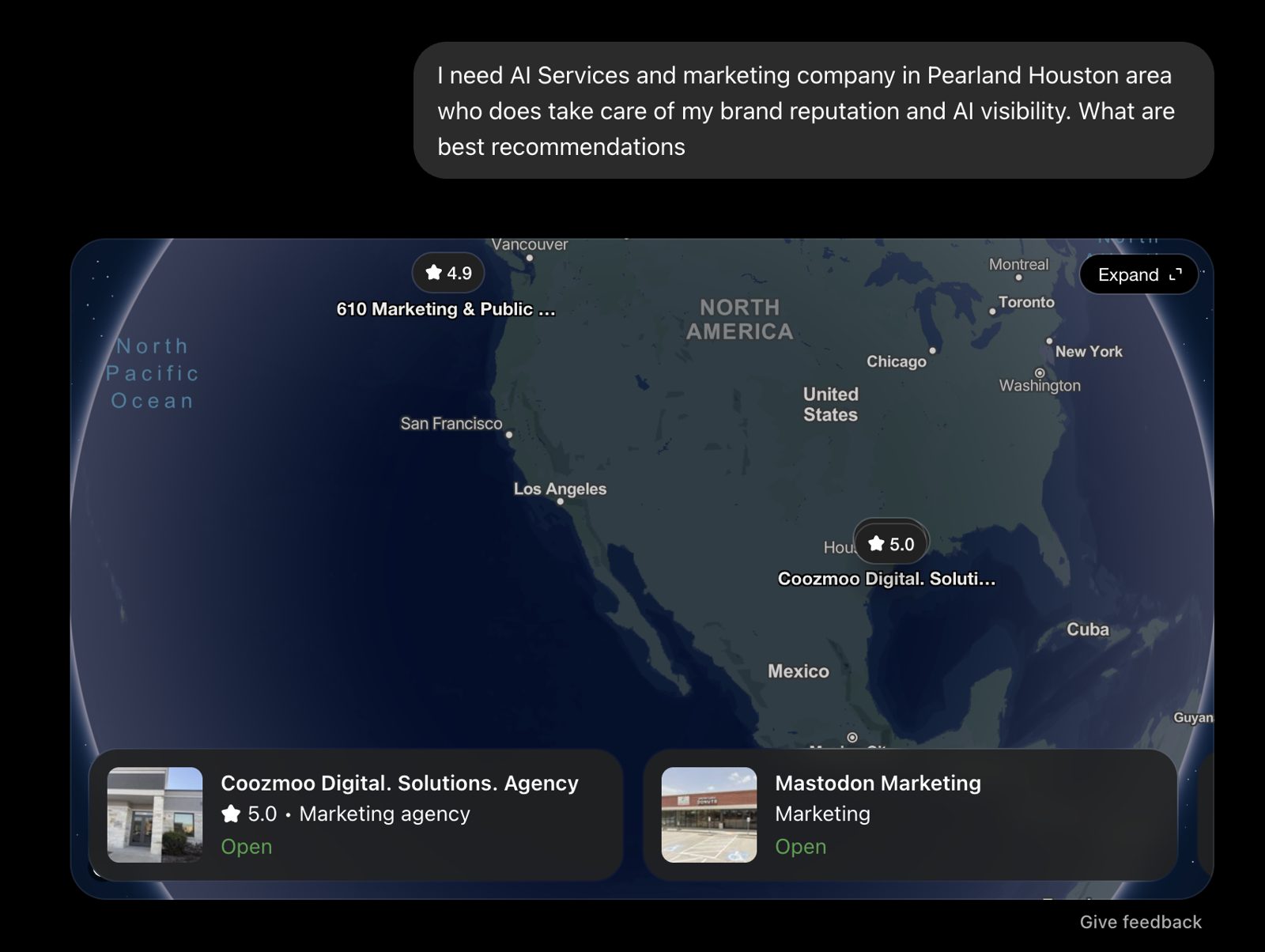
For twenty years, online reputation management followed a simple logic: reviews influenced the humans reading them. A prospective customer would land on your Google Business Profile or Yelp page, scan a handful of recent reviews, glance at the star rating, and decide whether to call you or your competitor. Your job was to make that moment of human judgment go your way.
That moment is disappearing.
Today, when someone asks ChatGPT for "the best dermatologist near me," asks Perplexity "which CRM has the smoothest onboarding," or lets Google's AI Mode compare three local HVAC companies, no human reads your reviews at all. A machine does. It reads all of them, every platform, every star rating, every complaint you never responded to, and compresses years of your reputation into a two-sentence recommendation that either includes your name or doesn't.
This is the fundamental shift: your reviews are no longer just social proof for customers. They are input data for the AI systems that now decide who gets recommended. Every review ever written about your business has quietly become part of the evidence layer that large language models learn from and retrieve against. Your reputation isn't just being read anymore. It's being computed.
How Are Consumers Using AI to Find and Choose Businesses?
If this sounds like a future problem, the numbers say otherwise.
A Local Consumer Review Survey found that 45% of consumers have used AI tools like ChatGPT, Gemini, or Perplexity to find local business recommendations in the past year, up from just 6% the year before. That's not gradual adoption; that's a channel going from fringe to mainstream in twelve months. AI is now the third most-used discovery channel for local businesses, ahead of Yelp and TripAdvisor.
Meanwhile, the funnel on the supply side is brutally narrow. SOCi's 2026 Local Visibility Index analyzed more than 350,000 business locations and found that ChatGPT recommends only about 1.2% of them when asked for a local option. The AI answer doesn't show ten blue links and a map full of pins. It names two or three businesses and stops. Everyone else is simply invisible, and there's no dashboard, no ranking report, no alert that tells you a prospect asked an AI about your category and your name never came up.
And what does the AI lean on when it picks those two or three names? Reviews, more than almost anything else. Research from Feefo found that ChatGPT references reviews in 58% of its responses, and Perplexity references them in 100% of responses. Roughly a third of Google AI Overviews cite at least one review platform. Businesses that ChatGPT recommends average around 4.3 stars across their review profiles.
Here's the paradox that makes this era genuinely strange: major review platforms have lost the majority of their organic search traffic as AI answers replace clicks, yet those same platforms are cited by AI more than ever. Fewer humans visit G2, Capterra, Trustpilot, or Yelp directly. But the AI reads them constantly, so your customers don't have to. Your review profile is now consumed almost entirely by machines acting on behalf of your future customers.
What Does "Your Reviews Are Training Data" Actually Mean?
To manage reputation in this era, it helps to understand the two distinct ways AI systems absorb your reviews, because each demands a different response from you.
First, there's the training layer. Large language models are trained on enormous snapshots of the public web: forums, directories, review platforms, news articles, Reddit threads, comparison posts. If your business has years of consistent, positive, specific mentions across that corpus, the model develops a durable internal association between your brand and your category — "this company" equals "trusted plumber in Austin" or "reliable payroll software for small agencies." That association is baked in. It persists even when the AI isn't actively searching the web. It's also slow to build and slow to erase, which cuts both ways: a strong reputation compounds for years, and a neglected or damaged one lingers long after you've cleaned up your act.
Second, there's the retrieval layer. When a user asks a question with local or current intent, modern AI assistants also search and read live web sources in real time — Bing-indexed pages, Yelp, Foursquare, the Better Business Bureau, Apple Maps, industry directories, Reddit discussions, and your own website. Testing by Search Engine Land and others indicates ChatGPT relies heavily on Bing-indexed results and third-party platforms rather than Google's review ecosystem directly, while Gemini draws on Google's own local data.
The practical implication is uncomfortable but clarifying: the AI doesn't see your reputation the way you do. You obsess over your Google star rating. The machine is cross-referencing Yelp, Facebook, Foursquare, BBB, niche industry directories, forum threads, and your website and checking whether they all tell the same story. If they disagree, or if half of them are empty and stale, the AI has weak evidence and quietly recommends someone else.
How Does AI Read Reviews Differently Than Humans?
A human skims your five most recent reviews. An AI system processes your entire review corpus and extracts patterns. That changes what "a good review profile" even means.
- Sentiment at scale beats individual gems. One glowing, beautifully written review moves a human. An AI weighs the aggregate: the ratio of positive to negative sentiment across hundreds of reviews and multiple platforms. A pattern of complaints about the same issue — slow response times, billing surprises, a rude front desk — becomes a machine-legible fact about your business, even if each individual review seemed minor at the time.
- Specificity is machine-readable evidence. Reviews that mention concrete services, locations, staff, timelines, and outcomes ("they replaced our water heater same-day and the quote matched the final invoice") give AI systems extractable claims to build recommendations on. Vague praise ("great company, 5 stars!") contributes to sentiment but tells the model nothing about what you're actually good at. The best reviews now function like structured data written in plain English.
- Recency is a trust signal. Around 74% of consumers say they only trust reviews from the last three months, and AI systems mirror this preference for freshness. A steady stream of five to ten new reviews per month signals a living, healthy business far more convincingly than two hundred reviews from 2022. Review velocity has become a ranking factor in everything but name.
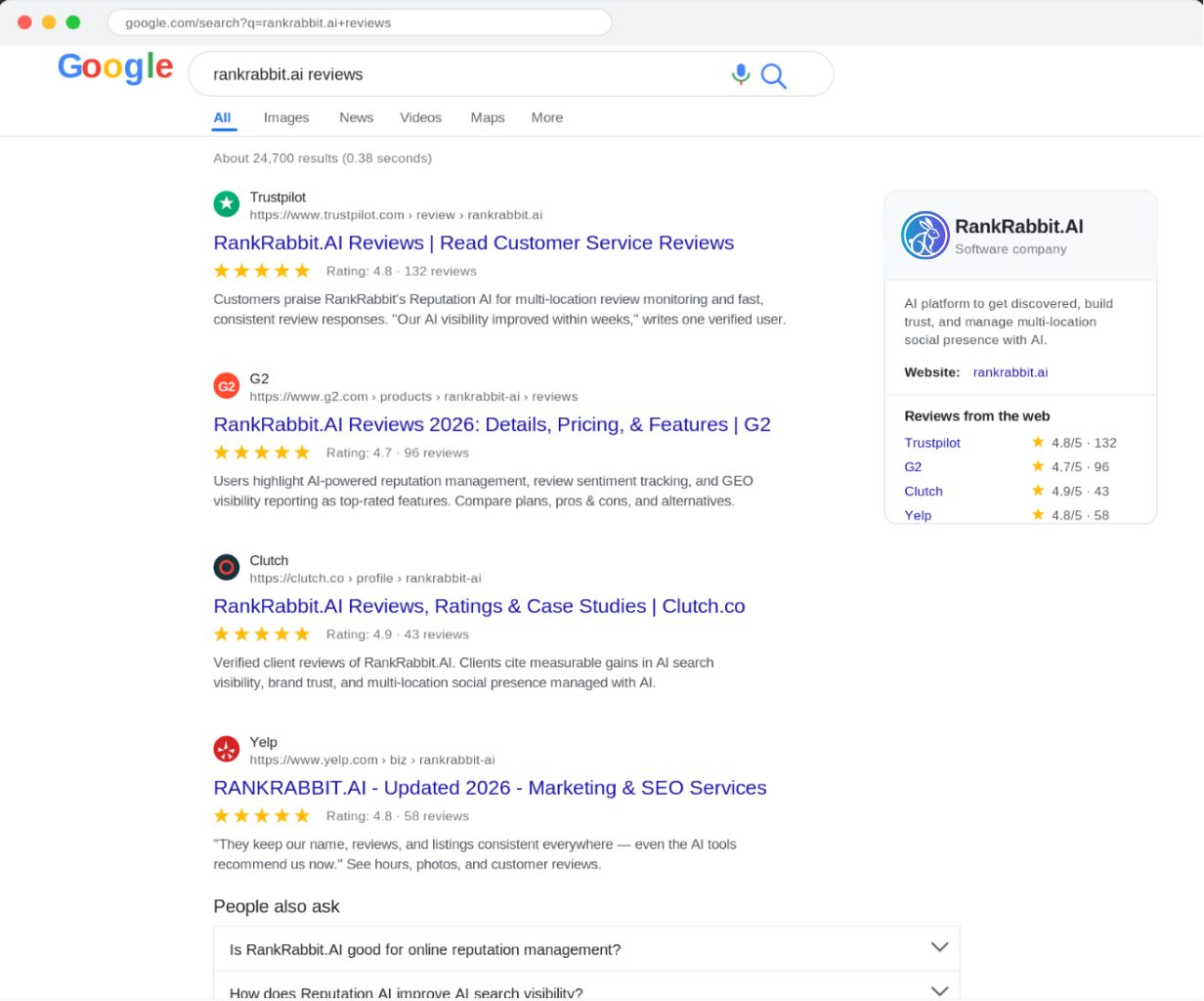
- Cross-platform coherence builds entity trust. When AI encounters the same business name, the same services, the same address, and the same broadly positive story on Google, Yelp, Facebook, Foursquare, and your own site, it develops what practitioners call entity coherence — confident, corroborated knowledge about who you are. When it encounters three different phone numbers, an outdated address on Apple Maps, and a Yelp page that contradicts your website, that confidence collapses. Inconsistency isn't just untidy anymore; it's disqualifying.
- Your responses are part of the data. Review responses were once customer-service theater performed for human onlookers. Now they're crawlable text that shapes how AI interprets a complaint. A thoughtful, factual response to a negative review adds context the model can weigh — "the business acknowledged the delay, explained the supply issue, and offered a refund" is a very different data point than an unanswered one-star rant sitting at the top of your profile.
Why Does the Old Reputation Management Playbook Fail in the AI Era?
Traditional reputation management was built around three assumptions that no longer hold.
It assumed one platform mattered most — usually Google — so businesses poured everything into their Google Business Profile and ignored the rest. But AI assistants deliberately triangulate across sources, and some of the most influential ones (Foursquare, Bing Places, BBB, vertical directories) are precisely the platforms businesses abandoned years ago.
It assumed reputation work was reactive — you managed reviews when something went wrong, suppressed a bad article, pushed a PR fire down to page two. But AI systems don't have a page two. There's no burying a pattern the model has already learned. In the training-data era, the only reliable strategy is proactive: building such a deep, consistent, positive footprint that negative signals are statistically drowned out before they matter.
And it assumed humans were the audience, so the goal was persuasion at the moment of reading. Now the first audience is a machine that summarizes your reputation before a human ever sees it. If the machine's summary excludes you, your persuasive Google profile never gets its moment.
How Do You Manage Your Online Reputation for the AI Era?
The playbook that actually works has seven parts, and they all pull in the same direction: give AI systems more high-quality, consistent, specific evidence than any competitor in your category.
- 1. Broaden your review footprint beyond Google. Actively earn and maintain reviews on the platforms AI actually reads for your vertical — Yelp, Facebook, Foursquare, Apple Maps, Bing Places, BBB, and industry-specific directories for local businesses; G2, Capterra, and TrustRadius for B2B and SaaS. A concentrated presence on Google alone is a single point of failure in an AI world.
- 2. Prompt for specifics, not stars. Ask happy customers to describe the exact service, the outcome, the timeline, the person who helped them. "They installed our tankless water heater in one visit and it's cut our gas bill by about a third" is a hundred times more valuable to an AI than "Great service!!"
- 3. Treat velocity as a KPI. Set a target for new reviews per month per location and instrument your operations to hit it — post-service SMS, receipt links, follow-up email flows. Consistent freshness beats hoarded volume.
- 4. Publish first-party proof on your own site. Case studies, detailed testimonials with names and outcomes, service-area pages, before/after data. Your website is one of the most trusted sources AI cross-references when validating claims made about you on third-party platforms.
- 5. Respond to everything, strategically. Treat every response as content written for two audiences: the human reading it and the model indexing it. Restate the service involved, address the substance factually, and close professionally. For negative reviews, your response is often the only counter-evidence the AI will ever see.
- 6. Lock down entity consistency. Same name, address, phone, categories, and service descriptions everywhere — website, GBP, Yelp, Apple Maps, Foursquare, directories, social profiles. Add LocalBusiness, Organization, and Review schema markup to your site so AI crawlers can verify facts against structured data. Every inconsistency you fix directly strengthens the machine's confidence in recommending you.
- 7. Monitor AI answers like you once monitored rankings. Reputation monitoring used to mean Google Alerts and review notifications. It now means systematically tracking how AI assistants answer questions about your brand, your category, and your competitors — and catching drift, inaccuracies, or exclusion early, before months of invisible lost demand accumulate.
What Changes for Multi-Location Businesses?
Everything above gets exponentially harder when you operate five, fifty, or five hundred locations. Each location has its own review profiles across each platform, its own sentiment patterns, its own consistency problems — and AI evaluates each location as its own entity while also forming an impression of the parent brand. One neglected location with a 3.2-star pattern of "long wait times" complaints doesn't just hurt that location; it feeds contradictory evidence into the model's understanding of your entire brand.
Manually monitoring, responding, and maintaining consistency across hundreds of location-platform combinations isn't a staffing problem. It's a category of work that simply cannot be done by hand anymore, which is exactly why reputation management is becoming an AI-versus-AI discipline.
How Does Reputation AI by RankRabbit Help?
This is the problem we built Reputation AI at RankRabbit to solve. If AI systems are reading your reviews at machine scale, managing your reputation at human scale is a losing game.
Reputation AI monitors your reviews and brand presence across the platforms that matter, for every location you operate, and surfaces the sentiment patterns AI models are learning about your business before they harden into how you're described in AI answers. It helps you respond to reviews quickly and consistently, so no complaint sits unanswered in the data AI retrieves. It keeps your multi-location presence coherent, so the story assistants find on one platform matches the story they find everywhere else. And it turns review collection into a continuous engine, so freshness — the signal both consumers and AI trust most — never becomes your weak point.
In short: it manages your reputation for the audience that now reads it first. The machines.
When Should You Start Optimizing Your Reputation for AI?
There's one more reason this deserves urgency rather than a spot on next quarter's roadmap: AI reputation compounds.
Every month, the businesses already being cited accumulate more reviews, more mentions, more corroborating signals — and every retraining cycle bakes those associations deeper into the models. Consumer adoption went from 6% to 45% in a single year; the discovery channel is being decided right now, and the early answers are becoming the default answers. The businesses that treat their reviews as training data today are writing the recommendations AI will give for years. The ones that don't will keep wondering why the phone rings less, with no report anywhere showing them the customers who asked an AI and were handed a competitor's name instead.
Final Thoughts
Online reputation management hasn't become less important in the AI era — it has become the foundation everything else sits on. Search visibility, AI recommendations, and customer trust now all draw from the same well: the reviews, ratings, responses, and mentions scattered across the web that machines read long before any human does.
The mental model worth carrying forward is simple. Your reputation has always been what people say about you when you're not in the room. In the AI era, it's what the machines learned from what people said — and the machines are always in the room. Every review earned, every response written, and every listing kept consistent is a data point you're feeding into the systems that will introduce you to your next thousand customers, or won't.
The good news is that this game rewards fundamentals, done consistently, at scale: earn specific reviews continuously, respond to everything, stay coherent across every platform AI reads, and monitor how AI actually describes you. None of it is mysterious — it's just impossible to sustain manually, which is why the winners will be the businesses that put AI to work on their own side of the equation.
Ready to see what AI is learning about your business? Explore Reputation AI by RankRabbit and take control of the data behind your recommendations.
FAQ
Do AI assistants really use reviews to make recommendations?
Yes. Research found ChatGPT references reviews in 58% of responses and Perplexity in 100%, while roughly a third of Google AI Overviews cite a review platform. Reviews function as independent validation that AI systems trust more than a brand's own marketing claims.
Which review platforms matter most for AI visibility?
It depends on your business type. Local businesses should prioritize Google, Yelp, Facebook, Foursquare, Apple Maps, Bing Places, and BBB, since ChatGPT-style retrieval leans heavily on Bing-indexed and third-party sources. B2B and SaaS companies should focus on G2, Capterra, and TrustRadius — the platforms most frequently cited in software-related AI answers.
How many reviews do I need?
Volume matters less than velocity and freshness. A steady flow of new, specific reviews each month across multiple platforms is more valuable to both consumers and AI systems than a large archive of old reviews — 74% of consumers only trust reviews from the last three months.
Can a bad review permanently damage my AI reputation?
A single bad review, no — but a pattern of similar complaints can become a learned fact about your business. The best defenses are responding factually to every negative review (your response becomes part of the retrievable record) and maintaining enough positive, specific review volume that isolated negatives carry little statistical weight.
Is this different from GEO (Generative Engine Optimization)?
They overlap. GEO covers everything that influences AI visibility — content, schema, mentions, authority. Reputation management is the trust layer within it: the review and sentiment data AI uses to decide not just whether it knows you, but whether it should recommend you.
Hastimal Jangid (HM) is a Co-founder at Coozmoo — the #1 rated AI-powered, data-driven digital marketing agency built to skyrocket revenue for small and medium-sized businesses — and the engineering mind behind RankRabbit.ai, Coozmoo's proprietary AI-powered growth platform that scaled to $2M ARR in its first year.
As Head of Cloud Engineering & Automation, he architects the technology backbone behind every service Coozmoo delivers — from AI-powered search visibility and paid media intelligence to e-commerce automation and conversion optimization. RankRabbit.ai sits at the center of this engine, combining agentic AI, intelligent automation, and real-time data intelligence to help SMBs dominate both traditional search engines and the next generation of AI-powered discovery platforms — ChatGPT, Perplexity, Gemini, and beyond.
A 4× AWS Certified Cloud Architect with 15+ years of experience, Hastimal brings a rare combination of deep technical engineering, fintech-grade discipline, and a founder's instinct for commercial impact. He doesn't just build systems — he builds systems that grow businesses. RankRabbit.ai is proof of that.
Ready to capture high-intent buyers?
See how RankRabbit helps your business rank everywhere — and win where it actually counts.