How Your Social Presence Shapes What AI Says About Your Brand

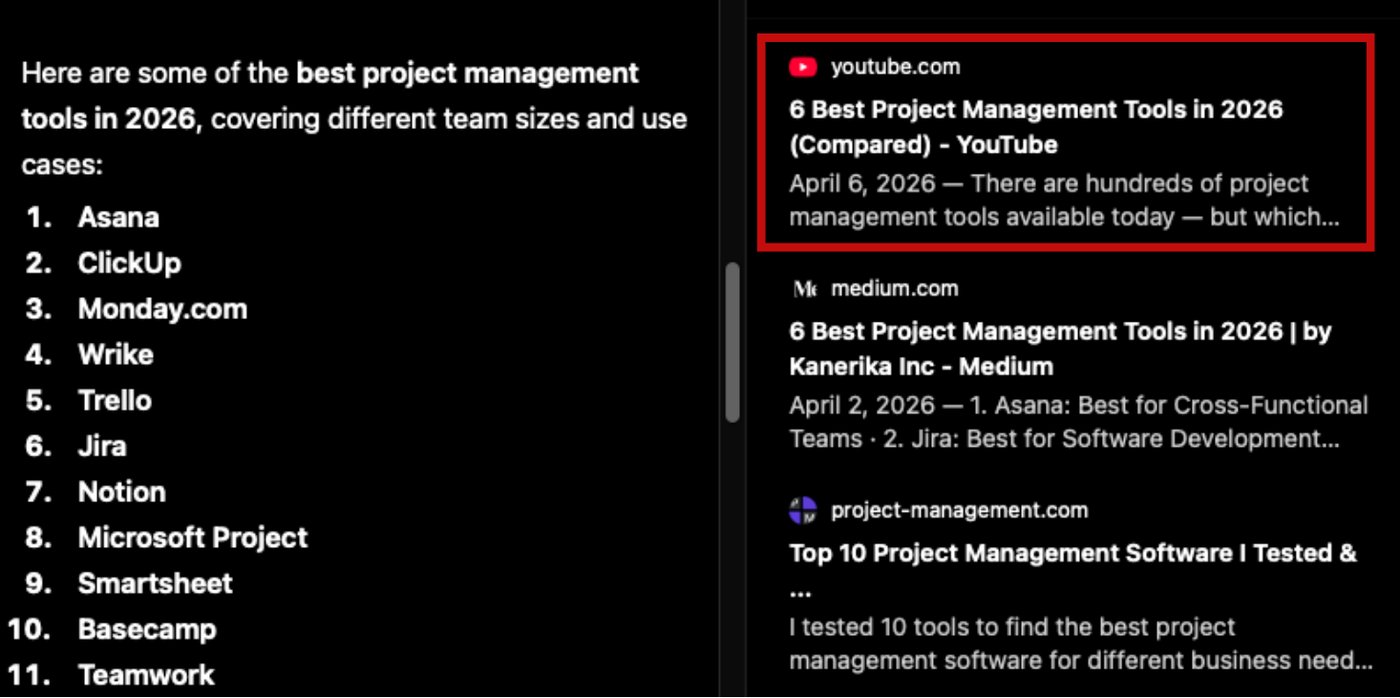
Ask ChatGPT to recommend a dentist in your city, a CRM for your agency, or a skincare brand worth trying, and it answers in seconds, naming specific businesses with complete confidence. Where did that confidence come from? Increasingly, from social platforms: a YouTube comparison video, a Reddit thread from last spring, a LinkedIn post, a cluster of Google reviews.
Your social presence has quietly become the raw material AI systems use to describe, judge, and recommend your brand. Yet most teams still run social purely as an engagement channel, unaware that machines are now their most attentive audience.
Below, we answer the questions marketers are actually asking about social signals and AI discovery — directly, with 2026 research, and without hype. Each answer stands on its own, so feel free to jump to the question keeping you up at night.
Does your social presence really shape what AI says about your brand?
Yes, and the influence is growing every quarter.
AI assistants build their answers from two layers: what they learned during training (massive snapshots of the public web, including licensed social data) and what they retrieve live when you ask a question. Social content feeds both layers.
The numbers make it concrete. Tinuiti's Q1 2026 AI Citation Trends report found that social media's share of all AI citations climbed steadily through the winter, passing 9% of citations across major AI platforms by January 2026. Reddit and YouTube supply nearly 78% of all social media citations in AI search. And brands with heavy mention footprints on community platforms were roughly four times more likely to be cited by AI than brands with minimal social discussion.
In short: when an AI describes your brand, there's a very good chance parts of that description trace back to something posted, discussed, or reviewed on social media, whether you put it there or not.
Which social platforms do AI tools actually listen to in 2026?
A small handful — and probably not the ones getting most of your budget.
AI citation behavior is brutally concentrated. Across every major 2026 study, the same short list dominates:
YouTube now leads. In January 2026, Adweek reported, with four independent research firms confirming, that YouTube overtook Reddit as the most cited social platform in AI answers, appearing in roughly 16% of LLM responses versus Reddit's 10%. Inside Google's AI ecosystem, YouTube's dominance is even stronger.
Reddit remains the community heavyweight, especially outside Google. Perplexity cites Reddit about six times more often than YouTube, and Tinuiti measured Reddit at 44% of all social citations within Google AI Overviews in January 2026. Reddit's licensing deals with both Google and OpenAI keep its conversations flowing straight into AI systems.
LinkedIn is the quiet third pillar, supplying roughly a quarter of ChatGPT's social citations in Otterly's data and over 40% of Microsoft Copilot's.
Everything else — Instagram, Facebook, TikTok, X — hovers around or below 1% each. These platforms restrict the crawling and licensing that AI systems depend on, so their enormous human audiences translate into almost no machine visibility.
Why did YouTube suddenly overtake Reddit as AI's favorite source?
Because every video ships with a machine's dream dataset attached.
For years, video was assumed to be invisible to language models. The opposite turned out to be true: every YouTube upload comes with a full transcript, chapters, a structured description, and a title that usually mirrors a real question — exactly the format AI retrieval systems digest most easily.
About 94% of AI citations to YouTube go to long-form videos rather than Shorts, and citations cluster around demonstrations, walkthroughs, how-tos, and comparisons — content that fully answers one specific question. YouTube's share of social AI citations roughly doubled between August and December 2025 while Reddit's share halved over the same window.
For brands, the takeaway is a genuine reset: a modest channel publishing clear, transcript-rich answer videos can earn more AI visibility than a celebrity creator with a hundred times the audience.
Do likes, followers, and viral posts make AI trust your brand more?
No. This is the most expensive myth in social media right now.
Across every major citation study, engagement metrics show essentially zero relationship with AI visibility. The correlation between YouTube popularity signals — views, likes, subscribers — and citation frequency is approximately nil. No research has found evidence that verified badges, follower counts, or viral reach act as inputs to AI answer selection. Google and OpenAI both describe their sourcing logic in terms of relevance, usefulness, and recency — not popularity.
Virality still helps indirectly: viral moments generate press coverage, backlinks, and community discussion, and AI systems do read those downstream traces. But the like count itself? Machines never see it, and wouldn't care if they did.
Stop measuring social success purely in engagement, and start asking whether each piece of content is the kind of clear, complete answer an AI would pull into a response.
Does posting more frequently improve your AI visibility?
Only if the posts are worth citing — but going silent definitely hurts.
Volume alone does nothing; AI systems reward evidence, not activity. What the research does support is a freshness effect: a positive correlation between content recency and citation frequency, strongest for queries that imply "now," "best," "latest," "2026," or "still worth it?" AI answers also churn constantly, with studies showing identical prompts frequently returning different brand lists from week to week, which means dormant brands get replaced by active ones.
Think of it as a pulse, not a firehose. A steady rhythm — one substantive video, one authored post, responsive review management every month — keeps your brand eligible for fresh retrieval. A three-month burst followed by silence reads, to a retrieval system, like a shop with the lights off.
Can AI actually read your videos, images, and carousels?
Yes, far better than most marketers assume — with one big caveat.
Modern multimodal models interpret images, screenshots, memes, and embedded text with high accuracy, and video content becomes fully machine-readable through transcripts and captions. YouTube auto-generates transcripts for every upload, which is precisely why it became AI's favorite social source.
The caveat: machine readability degrades with sloppiness. Text baked into stylized graphics, carousels with no captions, videos with garbled auto-transcripts, and images without alt text all leak meaning on the way into the machine. The fix costs almost nothing — write captions that make sense without the visual, correct your auto-transcripts, add alt text, and put the actual answer in the actual text of the post.
What happens when people criticize your brand on social media?
AI reads it, remembers it, and may repeat it to your next customer — for years.
AI systems synthesize criticism from reviews and community threads exactly as readily as praise. An unaddressed complaint thread or a cluster of ignored one-star reviews can surface in AI-generated brand descriptions long after the original incident, because both training data and retrieval favor exactly the kind of candid third-party content where criticism lives.
The mitigation is not suppression — deleted threads and legal threats tend to generate more discussion, not less. It's response and outweighing. A professional, public reply becomes part of the permanent record machines read alongside the complaint. And a steadily growing body of positive evidence — fresh reviews, helpful content, real community goodwill — gradually rebalances what the AI has to work with.
Do LinkedIn activity and personal branding carry weight in AI answers?
Yes — more than almost any other brand-controlled social activity.
LinkedIn occupies a unique position: AI systems appear to treat its substantive content — long-form posts, articles, active company pages — less like social chatter and more like retrievable professional literature. It nearly matched YouTube's total citation volume across tracked B2B brands in Superlines' data, and dominates Copilot's social sourcing.
The deeper signal is authorship. When named, credentialed humans from your company repeatedly publish real expertise next to your brand name, the model's association between your brand and your specialty hardens. Seer Interactive's research found brand awareness measurably correlates with how often LLMs mention a brand, and consistent personal branding is one of the few levers a company fully controls for building that recognition.
How do reviews and business profiles shape AI recommendations for local searches?
For local queries, they're not a factor — they're practically the whole answer.
When someone asks an AI assistant for "the best physiotherapist near Texas" or "a reliable AC repair service in Austin," the assistant leans overwhelmingly on the verification layer: business profiles, review volume and recency, response behavior, and the consistency of your name, category, hours, and services across every source it checks.
SE Ranking's research found businesses with active profiles on review platforms were about three times more likely to be surfaced in AI-generated local recommendations than those without. For local brands, the fastest path to AI visibility isn't more content — it's a cleaner, more responsive, more consistent verification footprint.
Why is AI visibility so much harder for multi-location brands?
Because you don't have one AI reputation — you have one per location, and AI judges each independently.
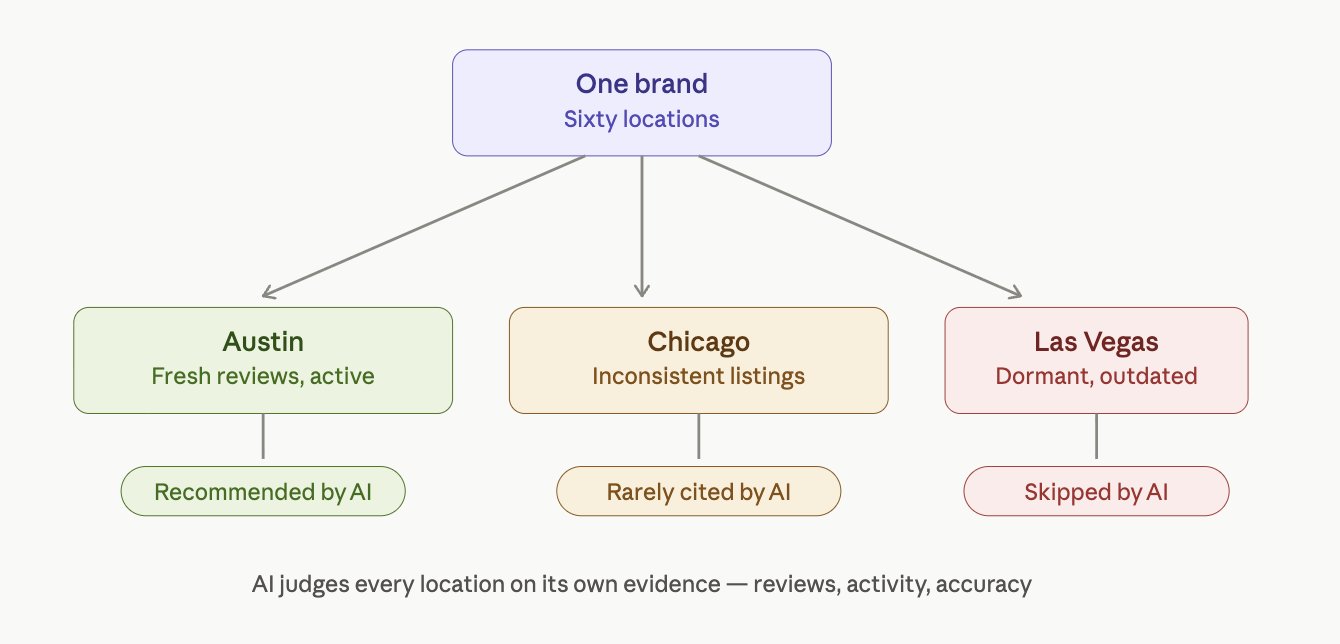
A brand with sixty locations effectively runs sixty separate evidence portfolios. Each location's reviews, response rate, posting activity, local mentions, and data accuracy get evaluated on their own when AI answers a local query. The Austin location with fresh reviews and weekly posts gets recommended; the Las Vegas location with a dormant profile and an outdated phone number gets skipped for the competitor next door — same brand, opposite outcomes, and head office never sees either conversation.
Keeping sixty footprints simultaneously accurate, active, and consistent is beyond manual effort for most teams, which is exactly the gap Social AI by RankRabbit was built to close. It helps brands get discovered and build trust by managing multi-location social presence with AI: every location stays consistent, current, and machine-readable, so each one sends the signals that make an AI comfortable recommending it — without multiplying your team's workload by the number of pins on the map.
How quickly does new social content show up in AI answers?
Anywhere from a few hours to a few weeks, depending on the pipeline.
Content on licensed platforms like Reddit can reach AI systems in near real time through direct data partnerships. Content that travels through search indexes — YouTube videos, LinkedIn articles, blog posts — typically appears in retrieval-based answers within hours to days of being indexed, faster for authoritative, well-linked sources. Influence on a model's deeper "memory" of your brand builds far more slowly, over months of accumulated presence, and only refreshes when models retrain.
The strategic read: retrieval rewards you fast, training rewards you eventually — so consistent publishing pays twice.
How can you measure and improve what AI says about your brand?
Audit first, then run a monthly rhythm against your baseline.
Start by seeing yourself as the machines do. Ask ChatGPT, Gemini, and Perplexity the ten questions your customers actually ask: "best [category] in [city]," "[your brand] vs [competitor]," "is [your brand] worth it?" Screenshot the answers, note which sources get cited, and, for multi-location brands, run the local queries per location. That baseline is your scoreboard.
Then work the levers this article has covered, roughly in this order: fix the verification layer (accurate, consistent profiles; every review answered), build the spoken record (long-form answer videos with clean transcripts), activate the paper trail (named experts publishing real expertise on LinkedIn), and earn the conversation trail (genuine, helpful presence in the communities where your customers gather).
Re-run your audit prompts monthly — AI answers are too volatile for one-off snapshots — and watch branded search volume as your lagging indicator: research shows brands cited in AI answers see measurable branded-search lifts over the following 30 to 90 days.
The bottom line
AI assistants have become the world's most influential word-of-mouth channel, and they form their opinions from the public, social evidence trail around your brand — the videos, threads, reviews, and posts that machines can actually read. The brands winning AI discovery in 2026 aren't the loudest on social; they're the ones whose footprint answers questions clearly, stays fresh, and holds consistent everywhere AI looks.
Build that footprint deliberately, one location and one honest answer at a time. And when the footprint outgrows the team, Social AI keeps every location's signals working for you — while you focus on being a brand the internet wants to vouch for.
Frequently asked questions
Do I still need traditional SEO if I'm optimizing for AI visibility?
Yes — SEO is the foundation, not the competitor. Most AI retrieval runs through search indexes, and Ahrefs found the vast majority of URLs ChatGPT cites are pulled directly from search. AI visibility adds new layers on top — brand mentions, community presence, video transcripts, per-location consistency — but crawlable, well-ranked content still gets you in the door.
Which AI platform should my brand prioritize first?
ChatGPT, by volume — it drives the overwhelming majority of measurable AI referral traffic (over 90% in Previsible's 2026 study of 6.77 million sessions). But citation behavior differs sharply by engine: Perplexity leans on Reddit, Google's AI surfaces favor YouTube, and Copilot favors LinkedIn. Audit where your customers ask questions, then weight accordingly.
Do hashtags still matter for AI comprehension?
Barely. Modern AI systems read meaning semantically, so a clear, descriptive caption does the heavy lifting. Hashtags can still offer light topical hints on short, messy posts, but a caption stuffed with thirty tags helps no machine and impresses no human. Two or three relevant tags is plenty.
Can a small business realistically compete with big brands in AI answers?
Yes — more realistically than in traditional search. AI systems reward specific, complete answers and fresh local signals over domain size, and popularity metrics show near-zero correlation with citations. A small clinic with clean profiles, answered reviews, and a handful of genuine transcript-rich videos can outrank a national chain's neglected local listing in its own neighborhood.
Does running paid social ads influence what AI says about my brand?
Not directly — ads aren't crawlable evidence, and no study has linked ad spend to AI citations. Indirectly, ads can spark the awareness that leads to searches, reviews, and community discussion, which AI does read. Treat paid as a demand driver, not an AI visibility lever.
Should I delete old or inactive social profiles?
Usually fix, don't delete. Inconsistent or outdated profiles actively contradict your brand's story in the verification layer AI cross-references. Update the information, align names and categories, and either maintain a minimal pulse or clearly redirect to your active channels. Delete only profiles you'll never maintain and that add no verification value.
How can we measure if social posts influence AI results?
Track it at the answer level, not the post level. Run your key customer prompts across ChatGPT, Gemini, and Perplexity on a fixed schedule; record whether your brand appears, what sentiment it carries, and which sources get cited; then map spikes and drops against your posting and review activity. Doing this manually across platforms and locations gets unmanageable fast, which is where Social AI by RankRabbit helps: it manages your social presence across every location with AI, keeping the signals consistent and fresh so you can connect what you publish to how AI talks about your brand — and improve both from one place.
Harsh Jangid is a Co-founder at Coozmoo — the #1 rated AI-powered, data-driven digital marketing agency built to skyrocket revenue for small and medium-sized businesses — and a driving force behind RankRabbit.ai, Coozmoo's proprietary AI-powered growth platform.
He leads growth, brand, and go-to-market at Coozmoo, translating deep customer insight into positioning, product, and campaigns that consistently outperform traditional agency playbooks. Under his leadership, RankRabbit.ai has become the visibility engine SMBs use to dominate both traditional search and the next generation of AI-powered discovery platforms — ChatGPT, Perplexity, Gemini, and beyond.
Harsh combines commercial instinct with an operator's discipline, obsessed with the specific question every founder actually cares about: is this moving revenue? That focus shapes everything RankRabbit ships — from Search AI and Listing AI to Social AI and Reputation AI.
Ready to capture high-intent buyers?
See how RankRabbit helps your business rank everywhere — and win where it actually counts.